





Build a strong Enterprise Resource Planning (ERP) team offshore by following these best practices:
- Choose offshoring for long-term development and outsourcing for short-term projects
- Partner with a high-quality offshore development company to recruit top talent (ERP talent hotspots include India, Ukraine, and Poland)
- Define your scope, unify your stakeholders, set up your governance structure, and properly onboard and engage your offshore team for long-term ERP success
You’ve heard it time and time again: digitise, digitise, digitise.
While AI has taken over digitisation discussions in recent years, CTOs shouldn’t forget that they have another powerful set of automation tools at their disposal: Enterprise Resource Planning systems, or ERPs.
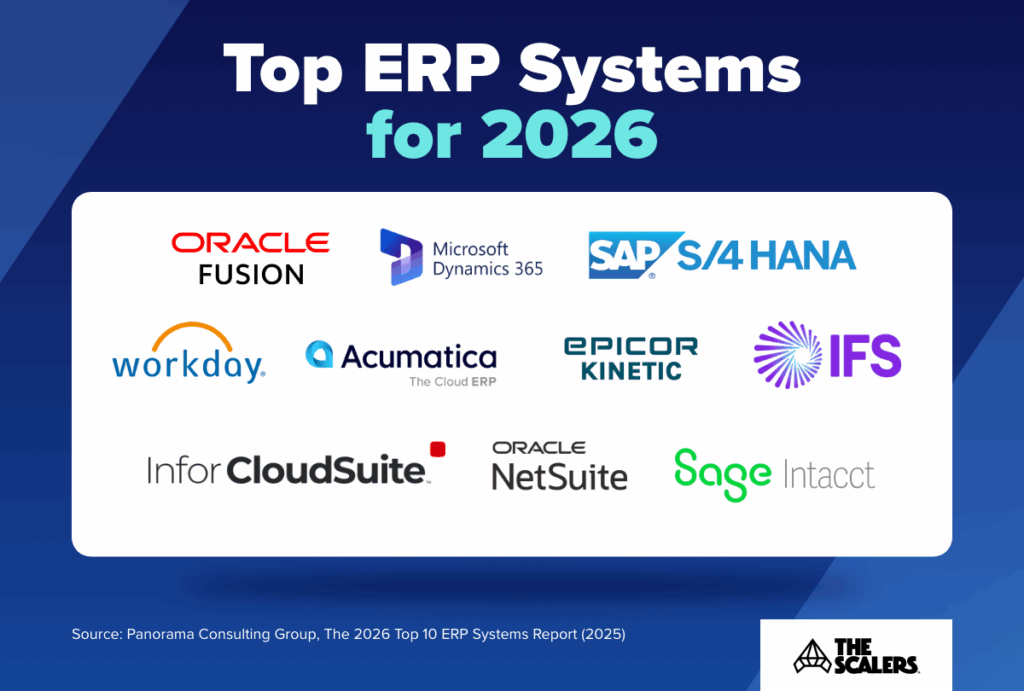
ERPs like SAP, Workday, and Microsoft Dynamics 365, when fully customised to the needs of your organisation, are key modernisation drivers that can transform operational efficiency and productivity, and improve the reliability of your reporting.
Whether you’re considering a full offshore ERP implementation or looking to expand your current capabilities, building an offshore ERP development team can help you find certified specialists and subject matter experts at the right price.
In this article, we will walk through top strategies for building an offshore ERP, plus common challenges and how to solve them, to make sure you’re scaling in a way that supports strong ROI.
What is an offshore team in ERP development?
An offshore ERP team refers to a group of software professionals who build, implement, and maintain ERP solutions for your organisation while located in another country.
While there are many different ways to hire offshore developers, generally, your ERP team will be recruited by a third-party offshoring services provider who collaborates with you to match profiles to the skill sets you need.
While an ERP can benefit practically every part of your organisation, from HR and finance to sales and marketing, these systems come with one key caveat: ERP modules can’t just be taken straight off the shelf and implemented.
Whether we’re talking about Oracle or Odoo, each ERP needs to be fully customised by experienced consultants who can tailor the base system to fit your specific processes, reporting needs, and access authorisations.
Getting this customisation right requires a comprehensive knowledge of your company, its governance structures, and the users who will be interacting with the ERP, which is why picking the correct offshore model for your needs is crucial when moving this development abroad.
Comparing offshore models for ERP development
Let’s focus on two of the main models that companies use to build offshore teams: offshoring and outsourcing.
While these terms are often used interchangeably, they actually represent two different ways to hire offshore ERP developers.
Whereas offshoring with a dedicated team involves hiring in-house professionals that simply sit in a remote office, outsourcing means contracting temporary profiles who are not incorporated into your organisation. Instead, these external developers work directly for the outsourcing company that is connecting you to talent, and are fully managed by that company.Essentially, outsourced teams are assigned to work on your project, complete it, and move on, whereas offshore teams are integrated into your organisation and stay with you long term.
While both models have benefits, there are specific use cases where one works better than the other. Let’s take a look at them.
| Offshoring is the better choice when: | Outsourcing is the better choice for: |
| Long‑term ERP ownership is criticalYou want knowledge to stay inside your business, not walk away with a vendor. | Short‑term or one‑off projects i.e., a quick SAP upgrade, patching, or compliance update. |
| You need cultural & process integrationOffshore teams can be embedded into your governance, unlike outsourced vendors who often stay at arm’s length. | Projects that have a clear, well‑defined scopeOutsourcing works best when requirements are fixed and measurable. |
| You want to invest in continuous ERP evolutionYour ERP needs ongoing enhancements, integrations, and support. | Hiring temporary specialists i.e., work on a niche ERP module (SAP SuccessFactors, Oracle Payroll) where you don’t need a permanent team. |
| You want real cost efficiencyOffshore teams give you access to a deep talent pool at a lower long-term cost. | Limited internal bandwidthi.e., your IT team is busy with core operations, so you outsource ERP reporting or testing. |
Key benefits of offshore ERP development
You can expect a few major benefits when extending your development capacity offshore, the top three being talent availability, domain experience, and cost effectiveness.
Talent availability
A complete ERP team is made up of three core departments: delivery, change management, and project management, plus data governance, compliance, legal, reporting, and analytics specialists.
Here are some of the key roles in each department:
Delivery
- Technical and functional consultants
- Integration specialists
- Data migration specialists
- QA and testers
- DevOps engineers
- Solution architects
Project management
- Project manager
- Scrum master
- Business analyst
- Program manager
Change management
- Training lead
- Trainers
- Communication specialists
Setting up in talent hotspots throughout Asia and Eastern Europe (more on that below!) gives you the possibility to tap into talent pools of highly specialised roles that may not be available at home.
Domain experience
Another key benefit of offshore ERP development is the domain experience found throughout these regions.
Let’s say you’re a London-based financial services company who wants to implement the Oracle ERP. The amount of senior or expert profiles who have experience implementing Oracle in the financial sector is likely to be limited at home.
This highly specific domain experience is something you’ll typically be able to find much more easily offshore, as these talent pools are rich with people who are either certified in a particular ERP, or are subject matter experts in a specific module.
Cost effectiveness
The final benefit is likely one of the major factors informing your move offshore: cost effectiveness.
While practically all major offshoring destinations will offer some degree of cost savings as opposed to setting up a comparable team in the UK, US, or Western Europe, the amount saved will vary country to country based on local salary benchmarks, taxes, talent specialisation and seniority, and your offshore development partner’s level of services.
Best countries for ERP development
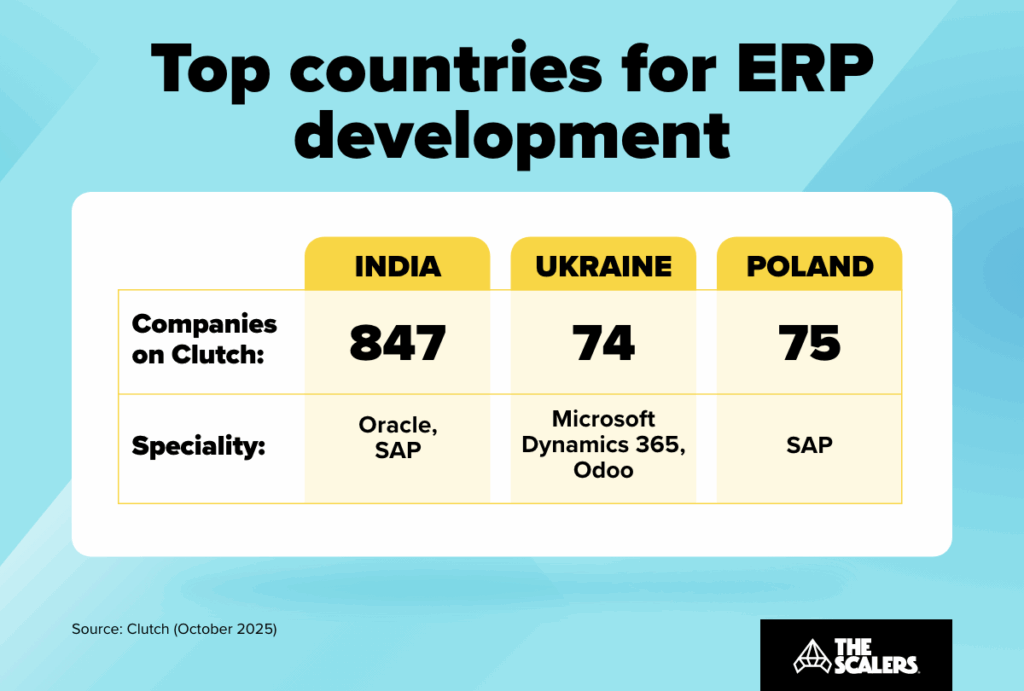
While there are dozens of offshore development hotspots around the globe, Asia and Eastern Europe are home to the top three countries for ERP development according to current Clutch data: India, Ukraine, and Poland.
India: A one-stop shop for ERP development
India is the world leader for ERP development, with almost 850 companies offering ERP consulting and SI services on Clutch.
Because of the country’s huge developer talent pool and its decades-long status as a global ERP leader, India is rich with developers that are either certified in, or have experience working with, a huge range of ERPs, particularly Oracle and SAP.
Setting up in India lets organisations easily build a team that can offer a 360-degree view of their system, handling that all-important ERP trifecta of development, implementation, and ongoing maintenance.
Alongside the depth of the talent pool, India also offers some of the most cost-effective developer rates globally.
Ukraine: A top-rated global ERP hub
Of the 73 Ukrainian firms offering ERP services on the platform, one is in the global top five, and three are in the top 15, according to Clutch’s Leaders Matrix for ERP Consultants.
ERPs like Microsoft Dynamics 365 and Odoo have become particularly popular in the country, a potential benefit for organisations looking for talent with experience in these domains.
Poland: A major European ERP player
With 75 companies offering ERP services on Clutch, Poland is another well-developed ERP hub in Central and Eastern Europe.
Polish engineers are particularly knowledgeable in the SAP ERP, one of the top ERPs globally by market size and the most popular SAP in Poland according to All for One.
How to hire the best offshore ERP developers
The first step to hiring the best offshore ERP developers has nothing to do with location or talent quality: it’s about making sure that all key stakeholders who will have a say in your offshore ERP team understand why your company is making this move in the first place.
Internal resistance or anxiety about going offshore can lead to hiring and other project implementation delays, especially if current team members who will be involved in the interview process perceive going offshore as a threat to their job security.
This can be largely avoided by holding a kick-off meeting where you fully brief all relevant stakeholders about why you’re building an offshore team, and how recruitment, workflows, and collaboration will look going forward.
After this, finding the best offshore ERP developers will depend on the quality of your offshore partner’s recruitment process.
These are some of the key steps:
- Employer branding: If you don’t already have a presence offshore, your partner should set up an employer branding campaign to establish your name in the local market and attract the best developers.
- Pre-screening: Pre-screening for soft skills will help you find developers with the right communication style and problem-solving abilities.
- Technical testing: Your offshore partner should conduct assessments customised to your specific tech requirements. As a general rule, use the same technical tests that you’d use if hiring at home.
- Interviews: After vetting candidates for soft and hard skills, final interviews can help you find developers with the right cultural fit.
Overcoming common challenges
While we’d like to stop here and promise you that setting up an offshore ERP team is going to be a walk in the park, the reality can look a bit different if you’re not set up to avoid common risks.
In our experience, here are some of the biggest challenges that come up with offshore ERP teams and some proven ways to solve them, or avoid them altogether.
Lack of top-down sponsorship and governance
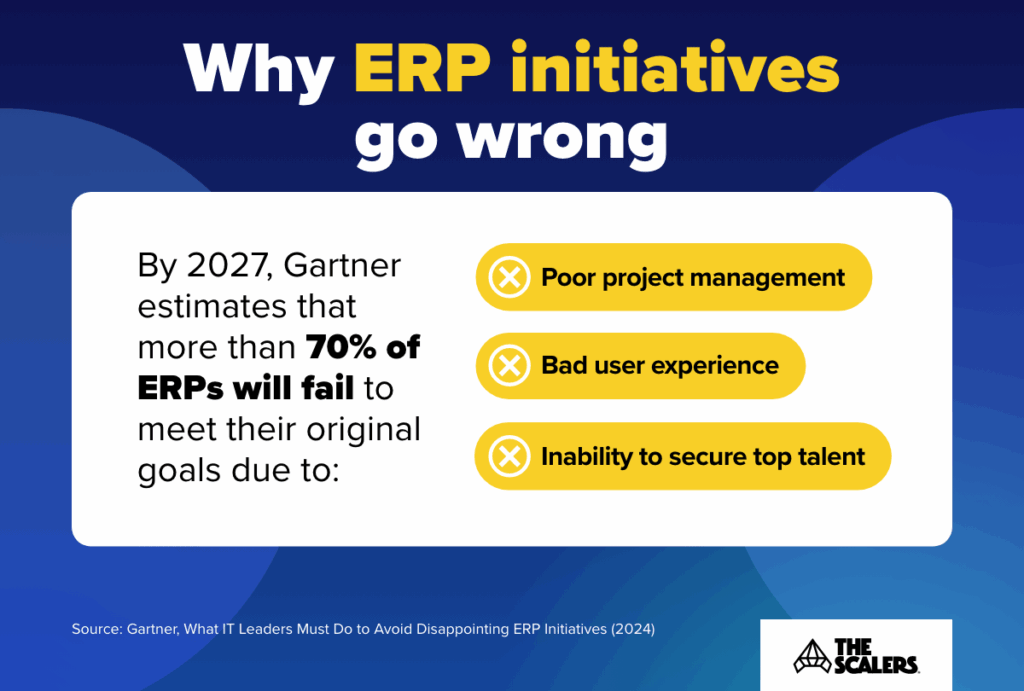
According to Gartner, 75% of companies fail to strongly align their ERP initiative to their broader business goals.
This lack of strategic planning and top-down sponsorship is one of the key factors that contributes to the high failure rate of ERP initiatives, both at-home and offshore.
Especially when moving this development abroad, having a clear offshore ERP strategy in place that aligns with your broader business goals and product roadmap is critical to properly manage offshore ERP projects. Without this in place, you may risk stakeholder and general organisational resistance that will hinder the success of your ERP initiative, or ultimately lead to its failure.
On top of this, without strong governance and quality controls in place, ERP deliverables can vary widely in quality, especially across different ERP modules, leading to a poor end-user experience and resistance to adopting the ERP.
When iterating ERP infrastructure, be sure to define roles, responsibilities, and your decision‑making model to ensure quality across the full complexity of the project.
In summary, you can set your ERP up for success by:
- Getting executive sponsorship early.
- Aligning ERP goals with business objectives.
- Appointing a steering committee to check or oversee governance.
Rushed knowledge transfer and onboarding
Ensuring that your offshore team fully understands business processes, compliance rules, and ERP configurations takes time and effort.
In other words, if you’re expecting your offshore team to get up and running in weeks without adequate onboarding or resource allocation, you’re setting your ERP initiative up to crash and burn.
In general, we recommend around three months for your offshore team to hit its stride.
While having rock-solid documentation and clear knowledge transfer is obviously essential for your developers to do their job correctly, one key strategy we’ve found that has worked well is assigning each new hire a buddy from the at-home team.
This buddy can answer any questions and guide them through their first tasks to ensure that they are fully oriented in your systems and are set up to work on their own going forward.
In summary, best onboarding practices include:
- Planning the three-month ramp-up.
- Connecting each offshore hire to an onshore buddy for knowledge transfer and cultural integration.
No remote team engagement
One of the worst mistakes you can make when building an offshore team is creating an “us and them” divide between local and remote teams.
Treating your offshore hires like the integral team members they are (and not simply cost-cutting “resources”) is a key element of modern offshoring, and also a core facet of building tech teams in the AI era.
Genuine engagement can include having developers work from a unified backlog, including all teams on all critical decisions, and building a culture that supports every developer, regardless of location, to voice their opinions and suggestions.
This can not only help with productivity and engagement but also, perhaps most importantly, retention.
In summary, don’t forget to:
- Treat offshore teams as core members.
- Use a unified backlog.
- Rotate sprint leadership.
- Include offshore teams in all critical decisions.
How to build an offshore ERP team: Step-by-step playbook
Building a top offshore team involves a combination of strong top-down sponsorship and governance, choosing the correct model and location, getting talent with the right skill set and cultural fit, and making sure your offshore team is fully integrated and engaged.
Here is a brief playbook summarising all of these core steps:
- Define your scope: Be clear on why the ERP is needed and what success looks like by setting up goals and metrics. Be sure to align your ERP strategy to your overall business goals.
- Unify your stakeholders: Secure leadership backing for the budget and authority.
- Choose the right offshore model: If you’re looking for a long-term ERP solution, building your own in-house offshore team is the best model. Outsourcing works better for short-term or small-scale projects.
- Select location: Choose a few offshore locations based on factors like talent availability, fully loaded costs to your company, and finding a partner that works with the offshore model you’re looking for. Top ERP development hotspots include India, Ukraine, and Poland.
- Choose the right partner: Evaluate offshore ERP implementation services, costs, case studies, and communication style to shortlist vendors.
- Design the team: Your core ERP team will typically include a project manager, solution architect, functional and technical consultants, and business analysts.
- Headhunting and interviews: Work with your offshore partner to assess communication and technical skills among developers, looking for certified ERP specialists or professionals who have proven experience in a particular module or domain.
- Validation: Involve department heads to validate requirements and processes.
- Set up your governance structure: Define roles, responsibilities, and your decision‑making model.
- Integrate infrastructure: Support functions like data migration, testing, security, compliance, change lead, super users, training, and communication.
- Support engagement and integration: Define your collaboration model, overlap hours, and tools. Ensure a comprehensive onboarding and give your team adequate support for the first three months.
- Long-term impact: Transition to a Centre of Excellence for continuous improvement.
If you’d like to dive deeper into some of these steps and see how to set up a world-class offshore team in India, check out our ultimate guide covering how to build an offshore team that actually works.
How PartyLite built a high-performance ERP team in Bangalore (and saved $700K per year)
Because of talent shortages in the US, ecommerce business PartyLite had been outsourcing development of their ERP, Oracle’s JD Edwards EnterpriseOne (JDE), for years.
Apart from the high costs associated with this model, their outsourcing partners weren’t delivering the real quality or integration they needed. PartyLite knew they needed to bring their ERP capability in‑house and stop “renting” knowledge from third parties.
And that’s exactly what they did in Bangalore with a 12-person integrated tech team skilled in JDE, as well as Magento, Mulesoft, and QA. ERP knowledge not only moved in-house rather than sitting with external vendors, they also saw a 2x boost in productivity and savings of $700,000 per year.
Conclusion
Building offshore ERP development teams can help you boost efficiency while keeping overheads in check.
Be sure to pick the right offshore model, and avoid common mistakes related to governance, communication, and remote team integration, and you’ll be on your way to transforming your organisation from the inside out.
FAQs
An ERP team can help you enhance the efficiency of practically any part of your organisation, from HR to sales. You can expect greater agility, more reliable and advanced reporting, and a more streamlined IT structure that will support your bottom line by boosting the productivity of your teams.
Here are some of the key ways to measure ROI in your offshore ERP initiative:
Productivity: Is your team more productive thanks to the ERP?
Efficiency: Are your processes and approvals more streamlined?
Upskilling and knowledge base: Is there more ERP knowledge within the company?
Speed: Can new ERP needs, such as compliance changes or module rollouts, be addressed more quickly?
Collaboration: Do your offshore engineers use the same tools and processes as in‑house staff?
Innovation: Once the basics are stable, is offshoring allowing for new integrations, automations, and analytics?
If you’re looking for a long-term ERP solution, a freelance consultant is unlikely to be able to offer the deep integration you need to build, implement, and maintain your ERP system. Instead, it’s best to work with consultants who are fully embedded into your organisation. They will have a better in-house understanding of the challenge at hand and the users who will be interacting with the ERP.
- Software licenses/subscriptions: This can be a one-time purchase for on-premise solutions or recurring subscription fees for cloud-based ERPs.
- Hardware (for on-premise): Servers, networking equipment, and other infrastructure if the ERP system is hosted internally.
- Implementation services: Fees for consultants to help with installation, configuration, customisation, data migration, and integration with existing systems. This is often a significant portion of the total cost.
- Customisation: Costs for tailoring the ERP to specific business processes that aren’t covered by standard features. This can include developing new reports, workflows, or integrations.
- Maintenance and support: Ongoing fees for technical support, software updates, and bug fixes.
- Integration: Costs associated with connecting the ERP system to other critical business applications (e.g., CRM, e-commerce platforms, HR systems).
- Personnel: Internal staff time dedicated to the ERP project, including project managers, subject matter experts, trainers, change management experts, and IT staff.
This will largely depend on the size and scale of your ERP project. Here are some general guidelines:
- Small businesses: 3-6 months
- Medium-sized businesses: 4-12 months
- Large businesses: 9-24 months, or longer for very complex projects
| Want help with setting up an offshore ERP development team in India? At The Scalers, we’ve built over 130 tech teams for organisations like PartyLite with our unique offshore model. If you’re interested in exploring how offshoring with us can help you establish or expand your ERP in India, send us a message. Our experts will analyse your exact needs and help you build a world-class team! |
Build Your Team,
Not Just a Contract
With The Scalers’ offshore dedicated development team, you get engineers who join your workflow for the long run. Grow steadily, stay flexible, and work with people who care about the product as much as you do.