


Most offshore teams that underperform have an operating model problem (not a talent one). Quick hiring with no structure behind it leads to:
- Engineers leaving before they understand the product.
- Product knowledge disappearing every time someone moves on.
- Hidden costs that weren’t part of the original conversation.
To fix that, you must rethink how your team is designed: who owns what, what seniority mix you need, and how engineers integrate in your organisation from day one.
I was recently speaking with a CTO at a UK travel company who had tried outsourcing but didn’t know what offshoring was. He (we’ll call him Samuel) thought they were both the same thing.
Samuel said they expanded their team with a few engineers, but “everything became harder to manage.”
So, what went wrong? Was it the talent? The location? I tend to think this is an operating model issue, and Samuel’s case is a perfect example of the bottlenecks others may be facing.
“Hiring is so quick, and everything looks cost-effective!”
The heading of this section describes what CTOs like Samuel might have thought after signing what appeared to be an ideal partnership. But the reality is that these too-good-to-be-true agreements (generally) just look good on paper.
Reality check #1: Poor attrition
The biggest problems usually show up much later.
A model that guarantees top talent in a fraction of the time for a very attractive price sounds fantastic, until you start losing engineers just as fast as you hired them. Two weeks to recruit, another two weeks before they’re gone.
In India, the market average attrition rate is around 30–35%, which is already high for most CTOs. Compare that to what the best offshore development companies can offer – at The Scalers, for instance, we record an attrition rate of 11%.
Reality check #2: People leave, and knowledge goes with them
One thing Samuel didn’t clock on at the start was how quickly knowledge can disappear when people move on.
He expected the engineers he brought in to settle in, grow into the product and become the people the business can rely on over time. But the setup wasn’t designed to keep people long term, and that only became obvious once people started leaving.
It wasn’t just a case of replacing a few engineers; a lot of the product understanding went with them, too. Now, the team wasn’t filling seats again, but they were also trying their best to recover knowledge they no longer had.
Reality check #3: Costs that show up later
Samuel didn’t budget for attrition or for knowledge gaps when people left.
But then come the extra costs, the ones that don’t show up at the beginning of a contract:
- Your plans change, but you’re locked into a contract. You might want to slow down or stop altogether. But you can’t. You can still end up paying when the setup no longer works for you.
- Let’s say you’ve built a team and six months later, the prices start going up. Once a supplier knows you rely on them, some begin pushing prices up well beyond what’s reasonable.
- The day rate sounds great, but then you notice charges for onboarding, project management, infrastructure, or bits no one ever properly mentioned.
If prices look low, it’s worth asking what’s behind them.
The before: Building for speed and speed only
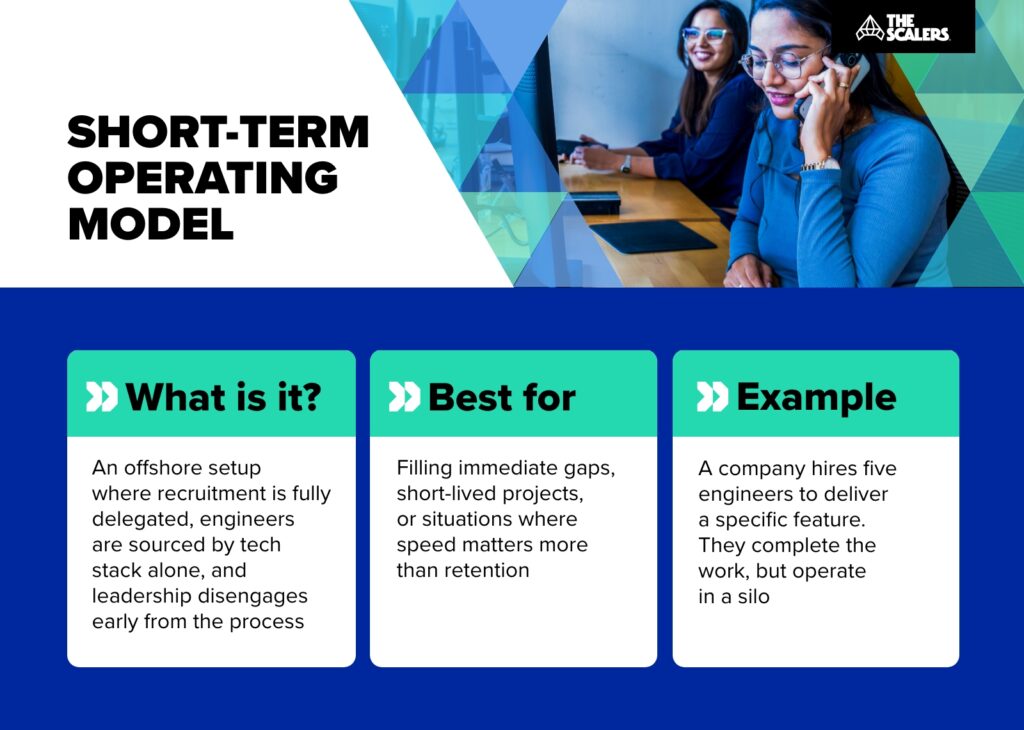
Going fast is not always wrong. Sometimes you need quick support, and you need it now. That was Samuel’s thinking. He chose a model that promised engineers almost immediately, which sounded ideal at the time.
What happened, though, was:
- Recruitment was handed over completely.
- Leadership stepped back early, assuming the right people would just “slot in”.
- Roles were written around tech skills, not ownership + culture fits.
- Engineers joined without really understanding the product, where it was heading and how they were expected to grow with it.
So short-term tasks do get done, but the setup never truly supports long-term growth. This is classic outsourcing rather than building an actual extension of the team.
The after: Building for long-term sustainability
Samuel already had a solid team of engineers. However, with the model he had, he was prone to poaching and losing knowledge whilst costs were increasing.
The second option solved that by putting proper structure around the team, giving clear ownership, stronger alignment and a reason to stay. The focus shifts from dealing with setbacks to actually achieving outcomes.
What we changed:
- We helped them reshape their job descriptions and helped him give proper ownership and responsibility to the offshore team.
- Instead of filling seats quickly, we balanced lead/senior engineers who could guide mid-level people who could deliver (making it more cost-effective).
- Focus shifted from just “tech stacks” to engineers who could think independently, understand product goals and work well in teams.
- Helped tighten up the tech stack, reduce tools, and clarify standards.
- A people-driven approach meant engineers were happier from the jump, who were integrated into the team with a mission and not just outsourced help.
What changed:
- Recruitment became more deliberate, leadership stayed involved where it mattered, so people joined with real context.
- Engineers arrived understanding what they were joining and knew what progression looked like for them.
- Samuel and the team spent more time moving forward than firefighting, as product knowledge stayed inside the team.
- Delivery became more predictable.
- Costs became easier to manage.
- Leadership could finally think longer-term, not just about immediate gaps.
The biggest win really is that the offshore team stopped feeling like an external add-on and started operating like a proper part of the business.
The biggest gains usually come from stability, not speed.
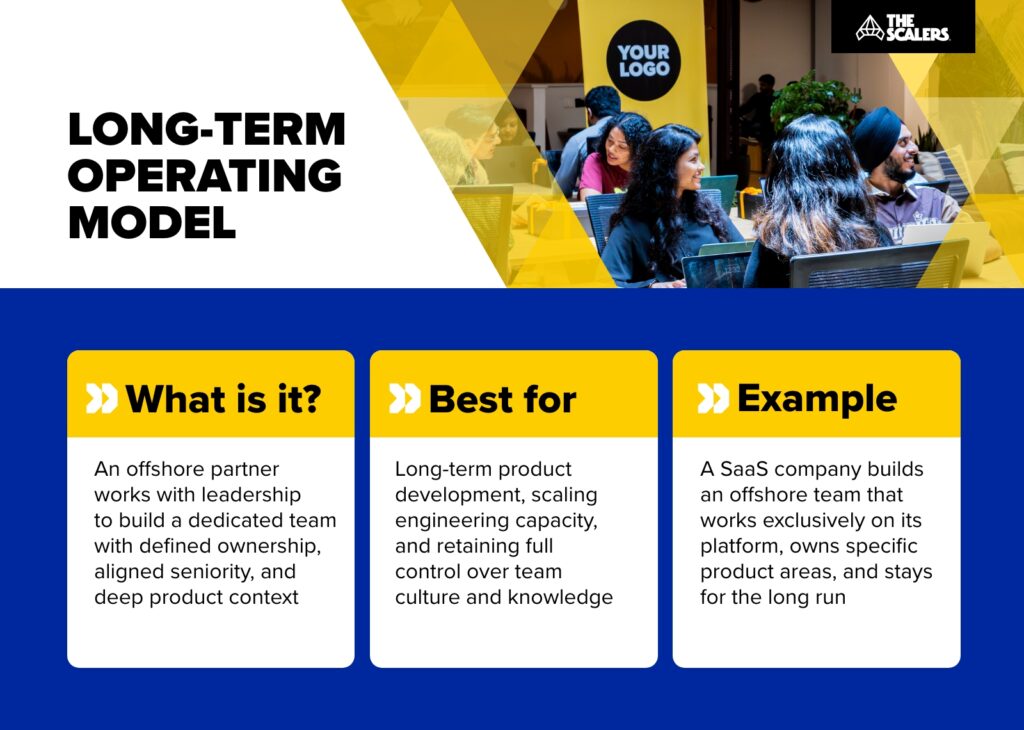
What the right operating model looks like
After reading the article, you might have a few questions. Is Samuel’s before-and-after a one-size-fits-all approach? What if my current setup is working fine?
We won’t sugarcoat it. Not every company needs to rethink how its offshore team operates. Some organisations have a model that works, and that’s fine.
But if, like Samuel, you’ve built an offshore team and things aren’t flowing correctly, the problem usually sits with the model they’re operating under. Fixing that is where the real difference happens.
At The Scalers, we’ve built 130+ tech and data teams in the last decade in Bangalore, India. Supporting businesses with high attrition rates, loss of knowledge, hidden costs, quick hiring with no ownership structure and a messy tech stack that nobody took responsibility for.
We’ve helped UK’s FinTech Preqin build a 450+ R&D Centre and US legal company Nexpoint build a Ruby on Rails team with the specialists they couldn’t find at home. This is one of many examples of scaling smart with larger teams, but also bespoke smaller teams (which is more common as of recently).
If you’d like to explore how this offshore model could support your goals, whether that’s scaling your platform, leveraging data, or just hiring the right people, send me a message. I’ll personally reach out and see what works best for your set up!
FAQs
It’s choosing an offshore model that prioritises speed and low cost over structure, ownership, and retention. Everything looks great at first, but without proper integration, seniority balance, and product context, teams start underperforming, and the real costs show up later through attrition, knowledge loss, and escalating fees.
The market average in India sits around 30–35%, which is already painful for most CTOs. For comparison, The Scalers records an attrition rate of 11%.
Because the rates look great on paper. What doesn’t show up at the start are the hidden costs: contract lock-ins that keep you paying even when the setup stops working, price increases once the supplier knows you depend on them, and extra charges for onboarding, project management, or infrastructure that nobody mentioned upfront. That’s why you should collaborate with an offshore development partner that is transparent and, ideally, bundles costs in a single all-inclusive monthly fee (covering engineer salaries, benefits, operational expenses, and support teams like HR and recruitment).
Build Your Team,
Not Just a Contract
With The Scalers’ offshore dedicated development team, you get engineers who join your workflow for the long run. Grow steadily, stay flexible, and work with people who care about the product as much as you do.