


We’ve evaluated seven companies that offer the Build-Operate-Transfer (BOT) model. Each provider on this list was measured against a consistent set of standards:
- A dedicated BOT service page describing the full lifecycle and commercial structure.
- Demonstrated ability to recruit, retain, and transfer tech and data talent at scale, backed by case studies, certifications, or third-party recognition.
- A minimum of five years of operating in the market, with publicly verifiable client references.
Organisations on this list build teams in some of the most popular offshoring locations, including India, Poland, and LATAM.
Companies typically look at BOT after they’ve validated offshore engineering with a smaller team and decided they want to own the operation outright.
For the right buyer, BOT compresses what would otherwise be a multi-year foundation effort (incorporating a local entity, building employer branding from scratch, navigating local labour law, leasing office space) into a partner-led process.
The seven companies we’ve analysed in this article have built a defined BOT service, with documented build, operate, and transfer phases and transparent commercials at every stage.
How does the Build-Operate-Transfer model work?
The Build-Operate-Transfer (BOT) model is a service delivery and engagement model in which an external partner (usually an offshore development company) sets up a dedicated development centre on your behalf (Build), runs day-to-day operations for a defined period (Operate) and then transfers full legal ownership (entity, employees, infrastructure and IP) to you (Transfer).
A typical BOT engagement looks like this:
- Build (6–12 months): Office setup, employer branding, recruitment of the core engineering team, and onboarding into your systems and culture.
- Operate (18–60 months): Your offshore team runs as an extension of your in-house engineering function. The partner handles HR, payroll, admin, compliance, and back-office support. You manage the work.
- Transfer (6–12 months): Final hires for support functions (payroll, HR, finance), asset migration and legal handover of the entity to your control.
This model is an excellent solution for organisations that have committed to a long-term offshore strategy and want to end up with a fully owned, integrated offshore hub.
How were the companies on this list selected?
Each provider on this list was measured against a consistent set of standards:
- A dedicated BOT service page: Every provider here has a publicly indexed, dedicated BOT solution page on its own domain that describes the build, operate, and transfer phases, the commercial structure, and the transfer mechanism.
- Tech and data talent as the core competency: We prioritised providers built around recruiting software engineers, QA, DevOps, data engineers, and adjacent technical roles, not generalist BPO operators who occasionally do BOT for back-office functions.
- Operational depth in their delivery geography: Every provider on this list has its own offices, HR, recruitment, and operations team on the ground in the market where they build teams.
- Proven track record: Every company here has either published BOT or GCC case studies, third-party recognition (e.g., Clutch), or at least 5 years of documented BOT engagements.
- Transparent commercial terms: We looked for clear per-employee or per-team pricing during operation, no opaque “transfer fees” buried in the small print, and reasonable minimum engagement periods.
Top 7 companies that offer the Build-Operate-Transfer model: Quick comparison
| Company | Builds teams in | Clutch rating as of 06/2026 | Best for |
| The Scalers | Bangalore, India | 4.8/5 | Companies wanting a long-term, fully owned engineering hub in India and complete legal ownership of the entity at transfer |
| ANSR | India | N/A* | Fortune 500 enterprises setting up large-scale Global Capability Centres (GCCs) in India |
| Spyrosoft | Delivery across Poland, Croatia, Romania, Germany, India, and Argentina | 4.9/5 | European companies wanting a nearshore BOT with full open-book cost transparency |
| Saigon Technology | Vietnam | 5.0/5 | Companies looking for a Vietnam-based BOT with documented end-to-end transfers under their belt |
| Alcor | Eastern Europe, LATAM | 4.9/5 | Tech companies wanting a European BOT with strong recruitment, EoR, and operational support bundled in |
| Cigniti Technologies (a Coforge company) | India | 4.9/5 | Enterprises wanting a virtual captive centre with QA, testing, and digital engineering at the core |
| Solugenix | India, LATAM | N/A* | US-headquartered companies wanting a long-established BOT partner with a transparent, tiered transfer model |
*ANSR and Solugenix do not have published reviews on Clutch, but we have included them in this ranking considering their strong dedicated BOT offerings and documented track records.
How to choose the right BOT partner
Here’s a framework for evaluating BOT companies before you sign anything.
Check their industry experience and recruitment depth
The provider’s prior experience in your industry (combined with their ability to recruit engineers who already understand your domain) will shape everything else about the engagement.
Ask companies to share named clients in your sector, case studies, and concrete examples of how their recruitment process sources engineers with relevant domain knowledge. In a mature offshore market like India, the best offshore partners can hire engineers who have already worked in FinTech, healthcare, e-commerce, AdTech, or whatever vertical you operate in, and they will tailor the team structure, recruitment profiles, technology stack, and operational protocols to fit the regulatory and technical demands of your industry.
A provider who pitches a generic “we can build any team” without specifics on their industry track record is usually one to keep an eye on.
Understand the cost model
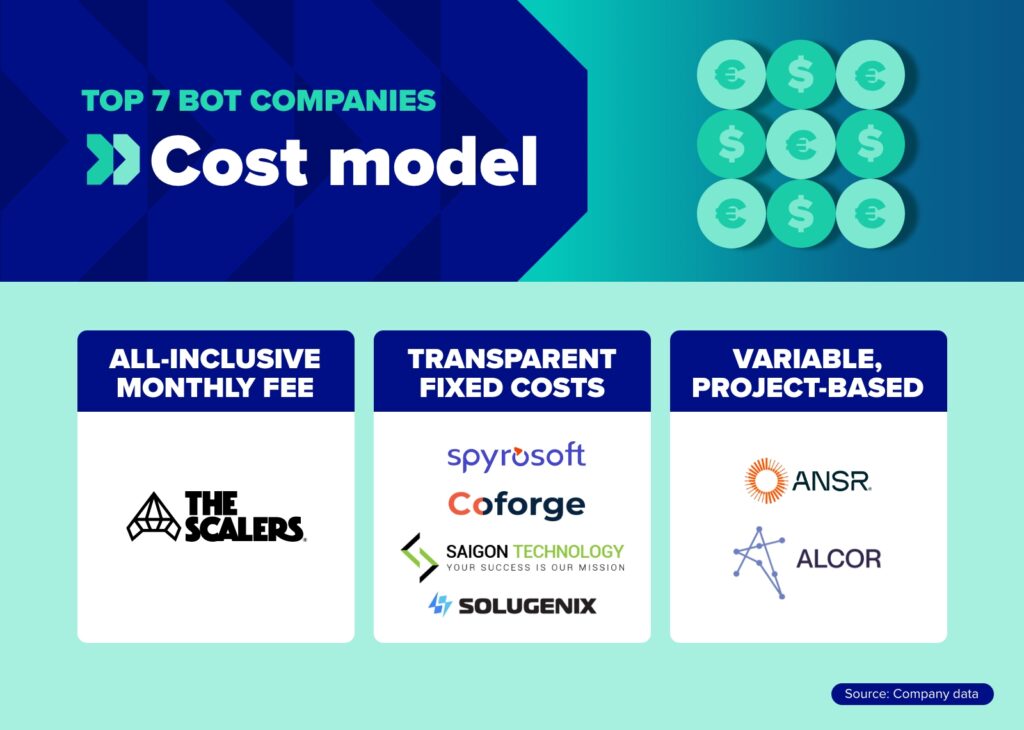
The BOT cost model typically consists of a single, transparent per-employee monthly fee that covers salary, infrastructure, equipment, HR, operations, and back-office support. Push for clarity on:
- What’s (really) included in the per-employee fee vs. what’s billed separately.
- Whether there’s a markup over base salary (and if so, how much).
- Notice periods, minimum engagement, and any early-termination clauses.
The cleanest BOT engagements have no upfront capital costs, no setup fee, and no per-hire recruitment fee. Some providers (like The Scalers) offer a single, all-inclusive monthly fee (covering salaries, equipment, admin, etc.) with no upfront costs.
Understand your level of control during the BOT operation phase
The Operate phase is where most BOT engagements spend the most time, so it’s worth being precise about what you control versus what your offshore development partner handles. Ideally, you maintain complete control over the workload, workflow, day-to-day priorities, and engineering decisions (your offshore team reports directly to your leadership and works on the tasks you assign).
The partner’s job during Operate is the operational backbone: procurement, payroll, admin, HR, retention initiatives, and any on-the-ground compliance work.
Ask every provider to walk you through that split in detail, and how those operational functions are gradually handed over to you as the transfer phase approaches. The clearer the line between what you manage and what the partner manages, the more your offshore team will feel like an extension of your in-house function, and the smoother the transfer will be when you take over.
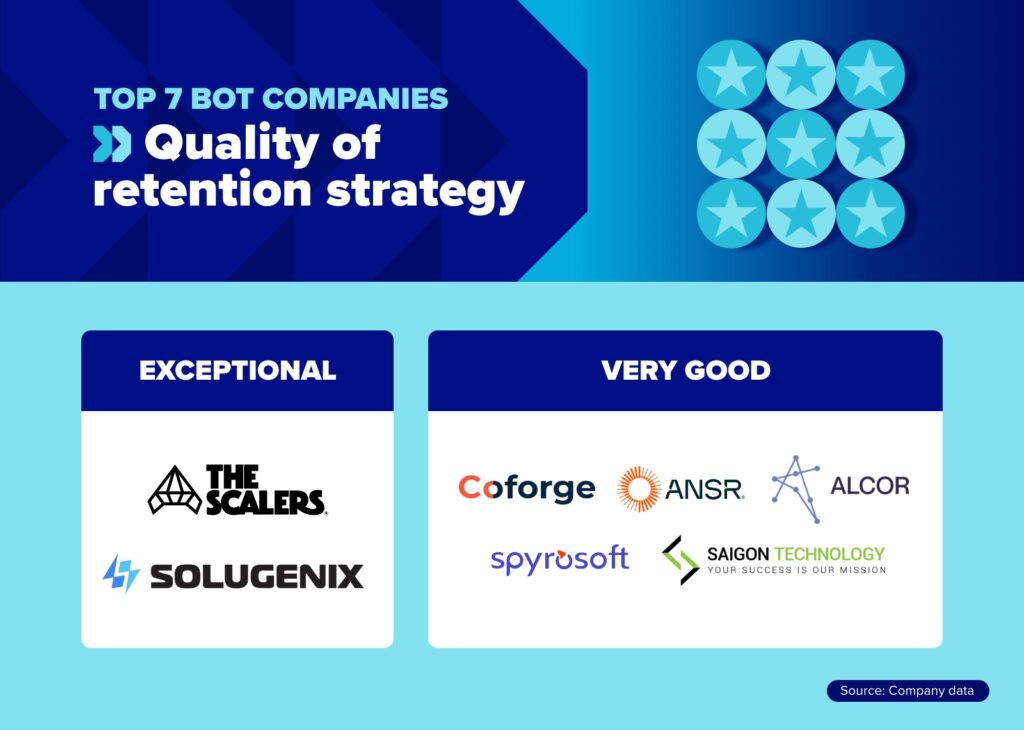
Have a look at attrition rates
Attrition is the silent killer in any long-term offshore engagement. Ask every provider:
- What’s the average attrition rate across your client engagements? How does it compare to the regional average?
- What concrete retention initiatives do you run (learning budgets, career progression frameworks, employee engagement programmes)?
- What’s the average tenure of engineers on your longest-running BOT engagements?
Top 7 companies that offer the Build-Operate-Transfer model: Deep dive
Here’s a closer look at the best providers that offer the Build-Operate-Transfer model:
The Scalers
- Operating since: 2014.
- Builds teams in: Bangalore, India.
- Partnerships: Preqin, Scania, Fintua, allpay, Johnson Health Tech, PartyLite, Nextpoint, Ykone, Basis Technologies.
- Key strengths: Great Place to Work certified, attrition below 11% (roughly half the Bangalore industry average), no upfront costs, transparent per-employee fee, no vendor lock-in, full legal ownership at transfer.
- Best for: Companies committing to a long-term, fully owned offshore engineering hub in Bangalore, who want a partner with a documented track record of building, scaling, and transferring teams.
The Scalers builds offshore tech and data teams in Bangalore, the Silicon Valley of Asia, with senior, AI-capable engineers. Since 2014, the company has built over 130 teams, primarily for SMBs and scale-ups in FinTech, retail, ecommerce, AdTech, and MarTech.
Their Build-Operate-Transfer model is designed for organisations that know they want their own entity in India and need a partner on the ground to make it happen.
Every engineer The Scalers hires works exclusively for each partner, matches that partner’s exact stack and culture, and reports directly to the partner’s leadership from day one. During the operation phase, the partner leverages The Scalers’ shared resources (recruitment, HR, finance, ops, payroll, admin). At transfer, the entire team, infrastructure, and IP move into the partner’s own Indian entity (they can assist in establishing one).
A standout BOT case study is Preqin, a UK financial data company that scaled from four to over 450 engineers in Bangalore before transferring out into its own entity.
We wanted to have our own team and make it very ‘Preqin’ and we wouldn’t have been able to build that team so quickly without The Scalers. They handled all of the hassles so we could spend our time building quality software and collecting quality data. And we wouldn’t have grown as Preqin without the team in India.
ANSR
- Operating since: 2004.
- Builds teams in: India.
- Partnerships: FedEx, Delta, Target.
- Key strengths: 200+ GCCs set up to date, named a Leader in the 2026 ISG Provider Lens for Global Capability Centre Services.
- Best for: Large enterprises and Fortune 500 organisations setting up a multi-hundred-person GCC in India under a BOT.
ANSR is a GCC and BOT service provider in India. They build BOT units as a client-owned GCC from day one: talent is hired against the client’s brand, the workspace is configured to client standards, and operational governance mirrors what the client would run internally.
Spyrosoft
- Operating since: 2016.
- Builds teams in: Poland (with delivery centres in Croatia, Romania, Germany, Argentina, and India).
- Partnerships: ING, Orange, Canal +.
- Key strengths: Open-book cost model that itemises administration, benefits, IT, recruitment, and management fees through every BOT phase.
- Best for: European and US companies wanting a nearshore BOT in Poland with full open-book cost transparency.
Spyrosoft structures its BOT model around three phases: Build (up to 3 months), Operate (up to 3 years), and Transfer (up to 3 months). The Build stage is available as a stand-alone engagement. The provider sets up the delivery centre, recruits the team, and runs day-to-day operations during Operate, before transferring employee contracts, agreements, and infrastructure into the client’s entity at the agreed milestone.
Saigon Technology
- Operating since: 2012.
- Builds teams in: Vietnam.
- Partnerships: Axiagram, ISMs Global, Baibai.
- Key strengths: 850+ projects delivered globally; ISO 9001 and ISO 27001 certified.
- Best for: Companies seeking a Vietnamese provider that offers a comprehensive BOT model.
Saigon Technology’s BOT model runs a Build phase of 2–6 months (4–6+ for larger or specialised teams), an Operate phase of 12–36 months, and a Transfer phase of 3–6 months. Through each phase, the provider handles office setup, local recruitment and onboarding, workflow management against agreed SLAs, and the eventual legal transfer of intellectual property, contracts, and infrastructure to the client’s entity.
Alcor
- Operating since: 2017.
- Builds teams in: Ukraine (with additional R&D delivery in Poland, Romania, Bulgaria, Mexico, Colombia, Argentina, and Chile).
- Partnerships: Dotmatics, Intel 471, Franki
- Key strengths: No legal entity required during Build and Operate, with the option to transfer at the agreed milestone.
- Best for: Tech companies wanting a European BOT with recruitment, EoR, and operational support bundled in.
Alcor packages BOT as an all-in-one service that combines tech recruitment, Employer of Record, and operational support (procurement and office rent, IT, HR, employer branding, insurance, payroll, and benefits). Per their published claims, the model targets a two-month launch, 30+ engineers in three months and 100+ within a year, with no buyout or hidden fees at transfer.
Cigniti Technologies (a Coforge company)
- Operating since: 1999 (Coforge announced majority-stake acquisition in May 2024; full merger completed April 2026).
- Builds teams in: India.
- Partnerships: Insulet, Adelphoi.
- Key strengths: Backed by parent company Coforge (Forbes Global 2000 IT services firm), giving the BOT engagement the operational depth and governance of a larger group.
- Best for: Enterprises wanting a virtual captive centre with the option to transfer internally once the centre is mature.
Cigniti’s BOT model is positioned around the “virtual captive centre” concept: a fully managed offshore extension with dedicated office space, redundant connectivity and power, local HR, recruitment, and payroll (with the option to convert the virtual captive into a wholly owned subsidiary when ready).
Solugenix
- Operating since: 1969.
- Builds teams in: Primarily India and the Dominican Republic, with additional delivery centres in Indonesia, the Philippines, and Canada.
- Partnerships: Iridium, EideBailly, Easterseals.
- Key strengths: 12+ BOT engagements completed, 5 currently active, and 1,000+ employees rebadged into client entities.
- Best for: US-headquartered companies wanting a long-established BOT partner with documented engagement numbers and a tiered transfer model that flexes with team size.
Solugenix’s BOT runs a pre-engagement Discover phase, a 1–3 month Build phase, a 1–12+ month Operate phase, and a final Transfer phase, with the provider handling legal entity formation, infrastructure, HR policies, recruitment, and governance throughout. At transfer, the client chooses how much of the operation to take over based on the size and maturity of the team.
Ready to set up your offshore tech hub?
The seven providers above all clear the basic bar of having a transparent BOT offering, but the right one for you will hinge on three things: the headcount you’re sizing for, the location where you want to build your team, and the partner’s documented transfer track record.
It’s also worth remembering that BOT isn’t the right model for every offshore setup. The economics typically only tip in your favour at scale. For some technologies and industries, around 20 employees starts to be the point where it makes financial sense to transfer ownership, but it’s usually closer to the 40 or even 60 employee mark. Below that threshold, a dedicated team extension or a fully managed offshore development centre is often the better starting point, with BOT remaining an option as your offshore footprint grows.
If you’re not sure whether BOT is the right fit for what you’re trying to build, fill out this form and speak with a member of our advisory team. They’ll walk you through your specific situation and help you assess whether BOT or another engagement model makes more sense for your business needs.
FAQs
The key difference is that, by the end of the engagement, the entire entity (including employees and other assets) is transferred from the offshore development partner to the company.
It depends on your offshore development partner’s model and established processes and other factors, like the size of your team. At The Scalers, the Build phase spans 6-12 months, Operate 18_60 months, and Transfer 6-12 months.
Yes, you need to set up your own legal entity in the target country. At The Scalers, we can assist our partners to complete that process, leveraging our expertise in the Indian market.
All employees are transferred to your company, along with other assets, documentation, and support systems, which are migrated to your own tools (ERP, HRMS, ATS).
Discover The Scalers' Build-Operate-Transfer model
See how the model works at every phase, from setting up your dedicated offshore centre in Bangalore, through day-to-day operations, to the eventual transfer of the team into your own legal entity.