




- An offshore development partner helps organisations build tech and data teams by sourcing top talent from locations with a high concentration of skilled professionals.
- Advantages of working with an offshore partner include access to elite, niche talent; cost-effective, transparent services; and support with recruitment, legal setup, and infrastructure.
- Look for a partner with proven experience who really offers great value for money, communicates clearly, and is committed to bridging cultural gaps for long-term success.
Offshoring is (still) perceived as a risky move by many organisations and tech leaders. They believe that building and scaling their tech and data teams means giving up control over their operations.
But that’s not the case when they find the right offshore development partner. We’re talking about companies that have built teams with elite talent and contributed to businesses’ success across multiple industries.
Choosing a partner is a decision you shouldn’t take lightly. Besides being responsible for setting up your new dev team, they also play a critical role in engaging your engineers and ensuring they remain aligned with your company’s goals, culture, and values from day one.
This evergreen guide, based on our experience building over 130 offshore teams in the past 10+ years, includes everything you need to know about offshore partners, from the advantages to the key factors to consider before partnering with one.
What is an offshore development partner?
An offshore development partner is a company that builds tech and data teams for other organisations in talent-rich locations. For example, an offshore partner can help a US FinTech set up or expand its Quant development team with skilled engineers in Bangalore, India.
Some of the best offshore development companies go beyond sourcing, hiring, and onboarding. They also manage infrastructure, legal, and administrative tasks on behalf of organisations and ensure engineers are happy and motivated daily through engagement initiatives.
How do offshore development partnerships work?
We could keep this simple and say that offshore development partnerships usually follow a familiar pattern: discovery, team setup, onboarding, and delivery.
We could also write about the importance of maintaining consistent, open communication between the offshore partner and the organisations, and of ensuring that processes and deadlines are managed in line with expectations.
And that would be true… but also a bit incomplete.
The best way to understand how offshore development really works is to look at real examples. This is the process we’ve refined at The Scalers, and it has helped us build long-term partnerships with companies of all sizes from varied industries:
- Discovery and deep dive. We start by understanding your context, your challenges, goals, tools, and the kind of team you need to build.
- Solution. Based on that context, we propose the setup that makes the most sense, whether that’s extending your existing team or building a dedicated offshore team from scratch.
- Contract negotiation and signing. Scope, pricing, timelines, and legal terms are agreed upfront, so expectations are clear on both sides at an early stage.
- Partner onboarding. You’re introduced to your Partner Success team, communication channels are set up, and the recruitment process is clearly explained before anything moves forward.
- Recruitment. We source and screen engineers who fit your needs, while also preparing the workspace, tools, and infrastructure for your new team.
- Engineer onboarding. Your engineers join your team and report directly to you, while we handle all operations on the ground.
One thing that often gets overlooked is that not every company is ready to offshore.
As Ryan Chana, Global Head of Advisory at The Scalers, often points out, the early conversations matter just as much as the delivery itself. Before we move forward, we spend time qualifying whether offshoring is genuinely the right fit.
That means asking direct questions around:
- What pain points you’re trying to solve.
- Whether the challenge is cost, talent scarcity, speed, or all three.
- Why offshoring or outsourcing feels like the right next step.
- Whether you’re looking for a long-term solution or a short-term fix.
In some cases, especially with very early-stage startups or companies still figuring out their core needs, we’ll be upfront and say we’re not the right partner yet. Offshoring works best when there’s a clear foundation to build on, not when it’s used as a quick patch.
Outsourcing vs. offshoring: choosing the right model
This qualification step also helps clarify an important distinction: outsourcing and offshoring aren’t the same.
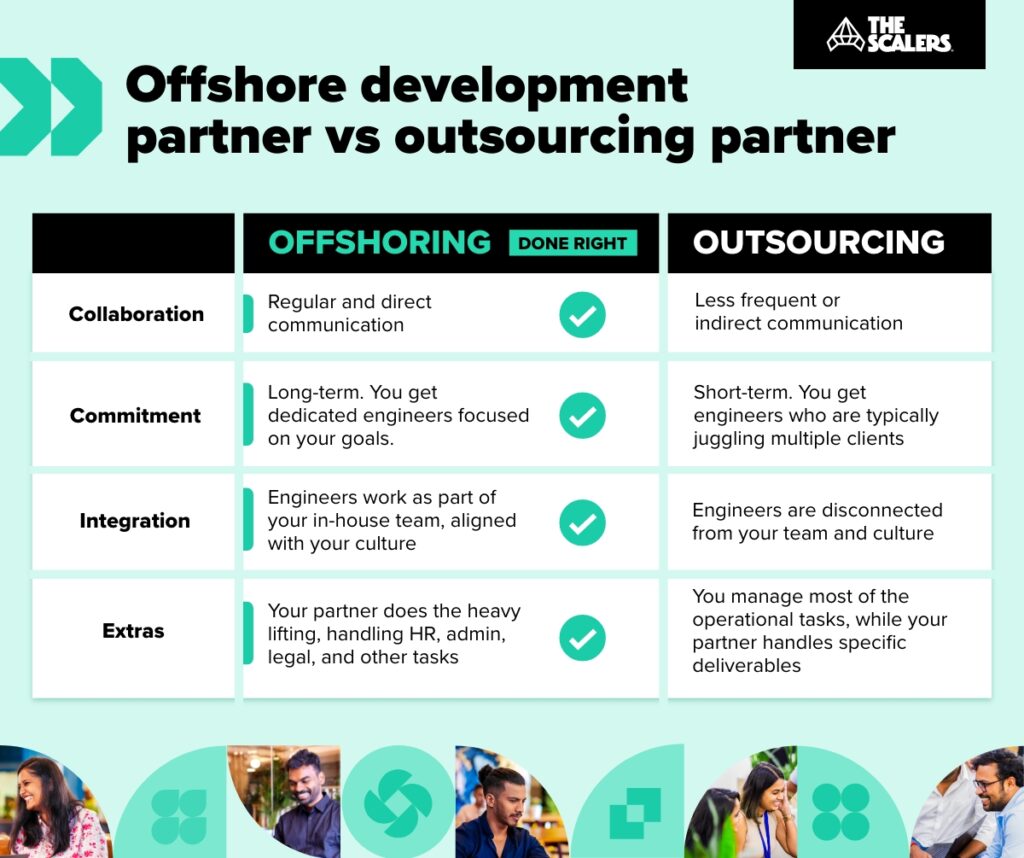
While outsourcing is often project-based and focused on short-term delivery, offshoring is about building a long-term extension of your team. In the table below, you can see a comparison of how offshore development partners operate versus what outsourcing partners do.
If you want to know more about the differences between the two approaches, you can check our article on outsourcing vs offshoring.
Advantages of choosing an offshore development partner
These are the main advantages you can enjoy when collaborating with a reliable offshore development partner:
- Accessing elite talent with in-demand and niche skills. Offshore development partners source engineers from some of the world’s top tech talent hubs. When you go offshore, you have the chance to build your team with highly specialised professionals you may struggle to find in your home market.
- Getting excellent value for money. Offshoring and cost-effectiveness go hand-in-hand. According to our research, companies that build offshore teams in India save 25-40% on total costs per-engineer.
- Concentrating on core business activities. When your partner handles time-consuming tasks like recruiting, HR, and administrative work, you can focus more on your product. Partnering with the right offshore company means delegating the heavy lifting to others while you spend most of your time making critical business decisions.
- Navigating local regulations and compliance requirements. A trusted offshore partner helps you understand and comply with local labour laws, regulations, and employment requirements in the country where your new team operates. They handle the complexity of cross-border work so you don’t have to become an expert in foreign legal systems.
- Having your whole infrastructure set up for you. Besides typical HR tasks, your partner will have everything your team needs in place before engineers start working, including a dedicated office space and equipment.
- Scaling your team as your business grows. A reliable partner can help you scale your team from a few engineers to over a hundred, depending on your needs and your expansion goals.
How to choose the right offshore development partner
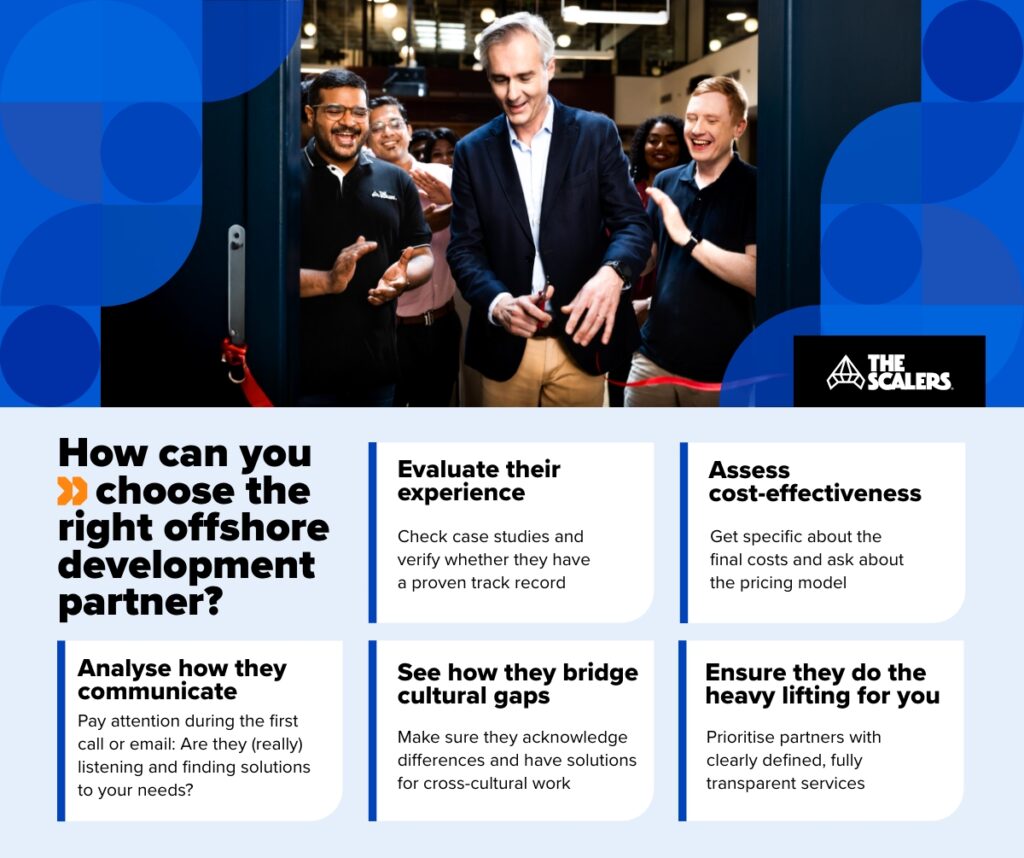
Before signing on the dotted line, look at the five key steps you should follow to choose the ideal offshore development partner for your organisation.
1. Evaluate their demonstrated experience
Your offshore software development partner should be able to showcase their successful work track record in building offshore teams with content pieces like case studies.
These materials can offer a window into what your potential partner can do and how well they do it.
When reading case studies, keep an eye on the following aspects:
- The approach: Analyse how they talk about their relationship with organisations and how they present the achieved results.
- The delivery: Does the case study show real understanding of the client’s business and challenges, or does it feel like a surface-level summary? How a company presents their work usually reflects how they operate.
- The vagueness: Rambling language, vague descriptions, and broad claims are red flags!
If you’re willing to go the extra mile, consider checking whether the past clients of your potential offshore development partner are still in business. Look for evidence of significant growth or positive changes in their operations.
2. Assess cost-effectiveness
One of the main benefits of offshoring is getting great value for money, as you can hire engineers with the same or even better skills than the ones you’d hire at home at a much lower cost.
While price is important, it’s a mistake to simply accept the cheapest offer. Generally, very low costs translate to very low-quality services. To ensure you get the best value for money, you must assess the cost-effectiveness of your partner’s services.
Get specific about the costs:
- How is pricing structured? Is it hourly, monthly per engineer, or a fixed-fee engagement model? Make sure you understand what’s included and what isn’t.
- When and how do payments work? Do you pay before the team is built or once engineers are onboarded? Are invoices monthly and predictable, or tied to milestones and delivery stages?
- What should you expect in the long term? Ask about timelines, future costs, and scalability. Is there a standard cost breakdown that shows how pricing typically evolves as your team grows?
When offshoring, you want to partner with an offshore development company that recruits elite talent for your business. But also one that delivers on its promises and offers an excellent, cost-effective service.
3. Evaluate their approach to communication
Communication is crucial when working with an offshore development partner based thousands of miles away and in a different time zone.
When discussing potential collaboration, take the time to understand how the company communicates. Learn about their project management/communication tools and plans for fostering open communication between your organisation and the offshore team.
In the early phases of your partner evaluation, pay attention to their responsiveness to emails and calls. Consider factors like the speed of their response and the politeness of their interactions, and pay attention to the company’s confidence and proficiency. Are they asking pertinent questions demonstrating deep technical expertise and understanding of your needs?
While early in the engagement, any communication red flags should be taken seriously, as they can indicate potential challenges down the line.
4. Analyse how they bridge cultural gaps
Building an offshore development team means working with people from different cultures, so it’s natural to encounter differences in communication styles and nuances that may be obvious to you but not to your offshore engineers.
Your offshore partner should acknowledge cultural gaps and propose solutions to bridge them. For instance, at The Scalers, some members of our leadership team have lived in India for years and act as a bridge between Western and Indian team members. We also take extra care to bridge cultural gaps during recruitment.
Discussions of cultural differences should be held openly when engaging with potential offshore development partners. If they seem hesitant, it’s a sign to be cautious.
5. Make sure they actually do the heavy lifting for you
The last thing you want is to agree on certain terms with your offshore partners, like admin work or infrastructure setup, to then see that they don’t really provide that service (beware of fine print), or it comes at an extra cost.
A partner with a proven track record in building long-term partnerships should be upfront about what they offer and how it’s delivered. Be wary of providers that promise “special” services on the spot just to close the deal, rather than clearly defining their scope from the start.
Questions to ask before selecting an offshore development partner
Besides the five steps analysed in the previous section, you should consider asking a few questions to ensure an offshore development partner is the right fit for your organisation:
Where do they source talent from?
If you’re looking to build a world-class tech team, you want your potential partner to source talent from some of the best software development countries. India, Poland, and Colombia are amongst the most popular offshore destinations, with professionals who possess niche programming skills and extensive experience working with Western companies.
What does their recruitment process involve?
Make sure you understand the exact process your potential partner follows to hire an engineer for your team. Consider how many people are involved in recruiting, how they test engineers’ skills and assess cultural fit, and how long it takes them to find the right candidates.
Can they build a team that works just for my business?
Theoretically, most offshore partners assign employees exclusively to one partner. However, you may encounter partners who hire specialists who juggle multiple clients. It’s crucial you verify that your potential partner is (actually) building tech teams with professionals who are 100% focused on your business.
Are they transparent with their pricing?
There are two types of partners when it comes to pricing: those who provide clear, upfront details about their services and rates and those who give vague answers. The latter often charge more through hidden fees that were not clearly disclosed during initial discussions. A reliable partner will always be transparent about pricing and timelines from the very beginning.
Will my data be secure with them?
Data privacy and security are some of the main concerns business and tech leaders have when going offshore. If that’s your case, ask your potential partner what certifications they hold and how they protect your data. For example, you can check if they have received the ISO 27001 accreditation. It’s also important to speak openly with your partner about any specific security requirements you may have, such as VPN access, restricted environments, or additional security measures.
Why is The Scalers a trusted offshore development partner?
At The Scalers, we build dedicated offshore tech and data teams in Bangalore, India.Thanks to our unique offshore model, we’ve helped organisations of all sizes scale their teams with specialists who have been pivotal in launching flagship products and keeping them at the top of their respective industries.
That’s the case with Nexpoint. This US-based Legal SaaS business launched a new SaaS product with the help of its Bangalore Ruby on Rails offshore team.
There’s nothing quite like The Scalers where our employees are literally our employees, not coming through any third party company. They know our culture, and our clients so they can execute meaningful code and deliver meaningful features.
Nextpoint’s success story wouldn’t have been possible without the unique advantages offered by The Scalers’ offshore model, which include, among others:
- A dedicated office equipped with all the goodies engineers need to perform at their best.
- Ongoing support of a Chief Happiness Officer (CHO) responsible for keeping engineers engaged, happy, and motivated. Some partners have said we aren’t the typical offshore provider and that we focus on employees as individuals first.
- A dedicated platform (OneTeam) that partners can use to monitor and track their teams, from recruitment to expenses and more.
Are you interested in learning more about our offshore model and how we can help you establish an elite tech team in India? Reach out to us by filling out this form, and one of our experts will get back to you shortly!
FAQs
Because it’s faster, more cost-effective, and scalable. Offshore partners give you access to niche talent that may be unavailable locally, while handling hiring and admin so you can focus on your core business.
By using strict security measures, certifications like ISO 27001, and clear legal agreements such as NDAs. The right partner puts guardrails in place to protect your IP and data.
Don’t choose based on cost alone. Avoid partners with vague processes, unclear pricing, or poor communication. Always check their track record, case studies, and client success stories.
With structured check-ins and modern collaboration tools. Many offshore teams even adjust schedules to ensure smooth communication with Europe and the US. With the right setup, time zone differences can be a strategic advantage, enabling extended development hours and support.
Treat your offshore engineers the same way you do with your onshore team. If you collaborate with an offshore development partner that prioritises keeping your engineers happy and motivated, you shouldn’t have any problem building strong bonds with your team.
Raise issues quickly and work with the partner’s business and technical leads to resolve them. A trusted partner provides senior expertise and ensures the team has the right support to overcome challenges.
As per our research, companies that go offshore can save up to 25-40% in total costs per engineer compared to what they’d pay locally.
Build Your Team,
Not Just a Contract
With The Scalers’ offshore dedicated development team, you get engineers who join your workflow for the long run. Grow steadily, stay flexible, and work with people who care about the product as much as you do.