






Top software development countries: a quick overview
Here’s a 2-minute analysis of the countries with the highest concentration of elite software development talent:.
- India has the second largest developer population in the world, just behind China. The country is known for being home to highly specialised tech talent with extensive experience collaborating with Western companies.
- Developer population: 6 million professionals.
- Major tech hubs: Bangalore, Hyderabad, and Chennai.
- China excels in areas like AI and 5G, with its engineers leading the way. The country’s race to become the most dominant economic superpower is (mainly) driven by its tech industry.
- Developer population: 7 million professionals.
- Major tech hubs: Beijing, Shanghai, and Shenzhen.
- The Philippines, compared to India and China, is small in size, and yet has a decent number of skilled engineers yearly with high English proficiency.
- Developer population: 190,000 professionals.
- Major tech hubs: Manila and Cebu City.
- Poland is one of Europe’s booming engineering powerhouses. Polish developers are among the most talented and respected professionals in the industry.
- Developer population: 300,000 professionals.
- Major tech hubs: Warsaw, Krakow, and Wroclaw.
- Romania has become a popular location for hiring engineering talent, especially for European companies looking for nearshore solutions.
- Developer population: 200,000 professionals.
- Major tech hubs: Bucharest and Cluj-Napoca.
- Colombia has a thriving startup ecosystem. The innovative vibe in its main cities is a sign of young and driven software developers.
- Developer population: 150,000 professionals.
- Major tech hubs: Bogota and Medellin.
- Argentina, despite quite a challenging socioeconomic situation, is a home for a constantly growing number of tech talent. Most developers work in outsourcing projects for US or European organisations.
- Developer population: 115,000 professionals.
- Major tech hubs: Buenos Aires and Cordoba.
Discover the world’s seven most talent-rich software development countries. If you’re looking for an overview of the elite talent pool, AI adoption, challenges and strengths of a given region – you’re in the right place.
TL;DR: See the below comparison table for top 7 best countries for offshore software development
| Country | Developer Population | Major Tech Hubs | Challenges | Strengths |
| India | 6 million professionals | Bangalore, Hyderabad, and Chennai | Finding the senior best-fitted talent within a huge talent pull | Budget-efficiency, talent pool maturity, Cloud, data, and AI upskill |
| China | 7 million professionals | Beijing, Shanghai, and Shenzhen | Impact of internal policies on international businesses | Specialisation in 5G technologies, AI technologies |
| The Philippines | 190,000 professionals | Manila and Cebu City | Long-term projects | Cost-effective rates, proficiency in English |
| Poland | 300,000 professionals | Warsaw, Krakow, and Wroclaw | Higher hourly rates | Leading european tech hub |
| Romania | 200,000 professionals | Bucharest and Cluj-Napoca | Emerging market in comparison to other listed countries | Increasing AI focus |
| Colombia | 150,000 professionals | Bogota and Medellin | Mostly the start up environment | Dynamic, specialised talent pool |
| Argentina | 115,000 professionals | Buenos Aires and Cordoba | Challenging economy | Strong educational background |
This overview is based on +10 years of experience and +145 offshore teams built by The Scalers.
In-depth analysis of the best countries for offshore software development
India
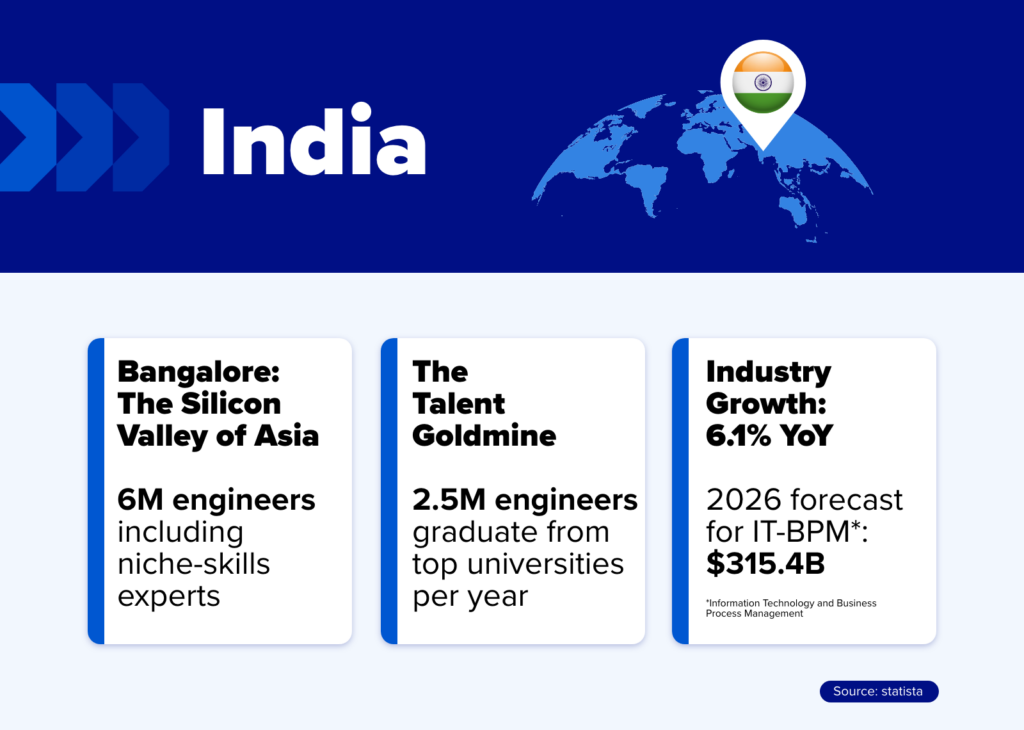
Developer population: 6M professionals.
Major tech hubs: Bangalore, Hyderabad, and Chennai.
India has the second largest developer population in the world, just behind China. The country is known for being home to highly specialised tech talent with extensive experience collaborating with Western companies. India is a talent goldmine – 2.5 million engineers graduate from top universities per year. Their unique problem-solving approach, niche programming skills, and high English proficiency make them stand out from counterparts in other regions.
Tech giants like Google, Meta, and Microsoft have Research and Development Centres (R&D Centres) in Bangalore – known as ‘The Silicon Valley of Asia’ – to harness this exceptional talent.
A major factor in India’s rise as a leader in software development is the investment the Indian government is making to drive innovation in new technologies. In 2024, they announced a $1.2 billion investment in AI projects. Recently, India’s government proposed a tax relief for localised offshore funds.
With this push comes a new wave of engineers equipped with the skills to help Western businesses thrive in this uncertain (yet exciting) technological era.
China
Developer population: 7M professionals.
Major tech hubs: Beijing, Shanghai, and Shenzhen.
With a market size of $2 trillion, China’s software development industry is booming and contributing to the nation’s overall growth. Thanks to public and private investment, the country is slowly taking over the US as a global tech leader. China’s race to become the most dominant economic superpower is (mainly) driven by its tech industry. The nation excels in areas like AI and 5G, with its engineers leading the way.
But what do engineering talent have to do with this? China has one of the world’s largest software development talent pools, with professionals who have contributed to building flagship products for renowned brands like Huawei, Lenovo, and Tencent.
These engineers graduate from prestigious institutions like Tsinghua University, ranked the 11th-best university in the world for studying engineering & technology per the 2024 QS World University Rankings.
Despite China’s advancements in AI and Machine Learning – with its AI market projected to reach $380 billion by 2026 – the nation’s challenging internal policies make it difficult for companies to build tech teams in the country.
The Philippines
Developer population: 190,000 professionals.
Major tech hubs: Manila and Cebu City.
Despite its small size – compared to India and China – the Philippines has a decent number of skilled engineers yearly with high English proficiency.
Filipino software developers are known for having some of Asia’s most competitive hourly rates, Engineers in Manila and Cebu City have a great affinity with Western culture — due to the nation’s historical ties with Spain and the US — and possess a very high proficiency in English.
Businesses that hire Filipino software developers often praise their excellent communication skills, professional etiquette, and strong commitment. However, they also note challenges in finding talent with niche skills. The country’s relatively smaller engineering community compared to other Asian nations restricts the availability of highly specialised engineers.
Poland
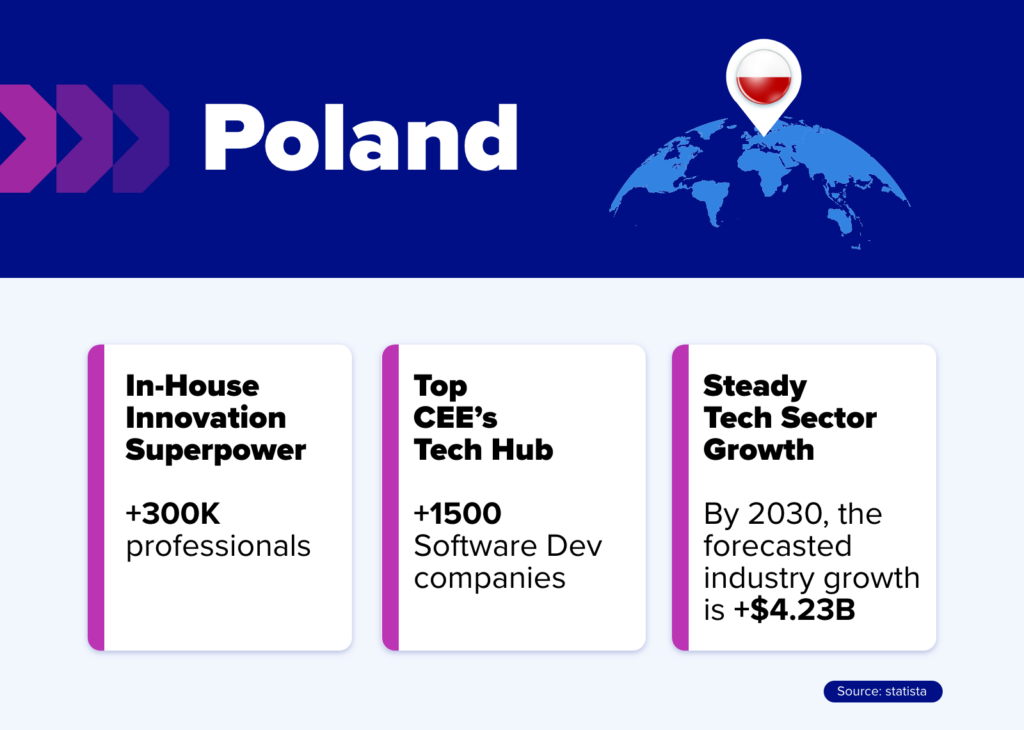
Developer population: 300,000 professionals.
Major tech hubs: Warsaw, Krakow, and Wroclaw.
Poland is one of Europe’s booming engineering powerhouses. Polish developers are among the most talented and respected professionals in the industry.
Poland is (arguably) the most prominent IT and software development hub in Central and Eastern Europe. Recent figures reveal that around 1,500 custom software development companies provide outsourcing and staff augmentation services in the country.
The growth of Poland’s software industry – driving the country to emerge as Europe’s next tech superpower – goes hand in hand with in-house product innovation. The country has its own PayPal and Amazon-like services: Blik, Allegro, and InPost.
This would be impossible without the contributions of a vast pool of elite engineering talent. And Poland is often among the first countries mentioned when discussing where the world’s most talented developers are.
The drawback of hiring Polish tech talent is their high hourly rates. What was once an affordable solution for US and UK companies seeking top engineers is now less appealing, as Polish professionals’ salaries have become comparable to those in Western countries.
Romania
Developer population: 200,000 professionals.
Major tech hubs: Bucharest and Cluj-Napoca.
Romania has become a popular location for hiring engineering talent, especially for European companies looking for nearshore solutions. While its IT ecosystem and infrastructure aren’t as developed as Poland’s, the Balkan country is attracting organisations who want to hire top-notch software developers at a fraction of what they’d pay at home.
Tech corporations like IBM, HP, and Oracle have established R&D centres in the country, employing some of the most talented engineers in Bucharest and Cluj-Napoja.
Romania is making notable progress as programming shifts towards no-code, low-code, and automation.
While the country excels in innovation and production, it lags slightly in technology adoption. Despite this, Romania is producing leading AI applications like DRUID AI, positioning itself to capitalise on future industry trends.
Colombia
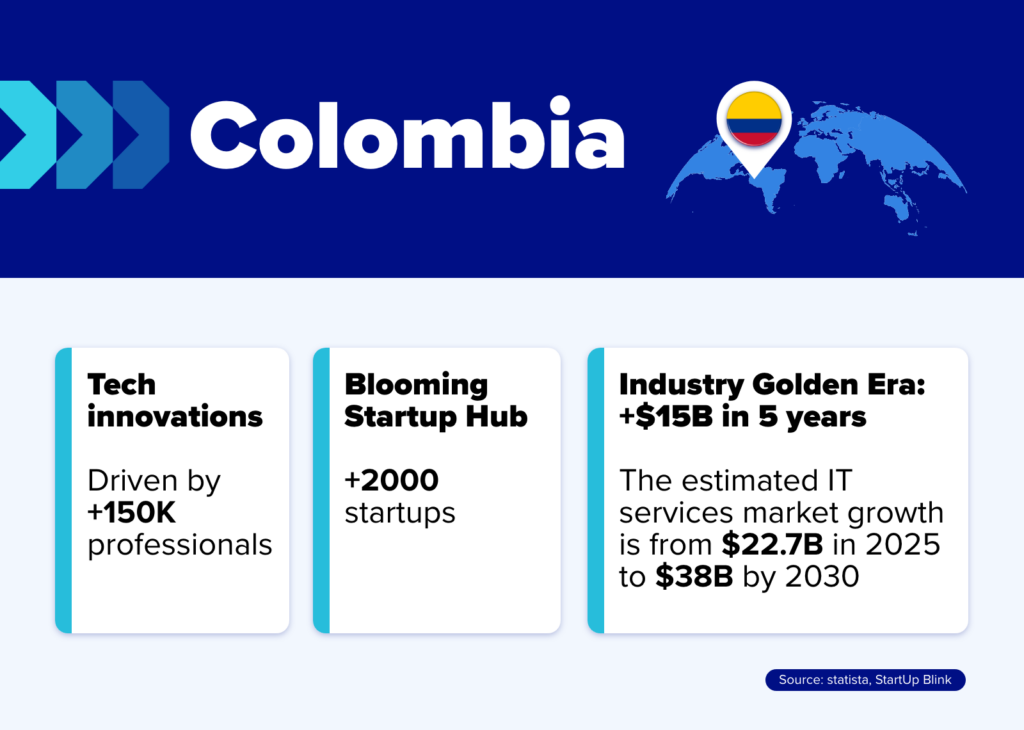
Developer population: 150,000 professionals.
Major tech hubs: Bogota and Medellin.
Colombia has a thriving startup ecosystem. The innovative vibe in its main cities is a sign of young and driven software developers.
Colombia’s flourishing tech industry can’t be explained without considering the contribution of its +2,000 startups in cities like Medellin and Bogota. Notable companies include Rappi, Bold, and Platzi.
The focus on innovation and investment in sectors like banking and finance has cultivated a dynamic and highly specialised software development talent pool in Colombia. Thus, the country has become a popular nearshore destination for US companies seeking engineers with experience in FinTech.
Entrepreneurship and networking events like Gofest and Capital Summit point to a promising future for the Colombian startup ecosystem and its talented developers.
Argentina
Developer population: 115,000 professionals.
Major tech hubs: Buenos Aires and Cordoba.
Argentina’s challenging socioeconomic situation in the last decades hasn’t affected the growing number of tech talent flourishing. Most developers work in outsourcing projects for US or European organisations and have a strong US outsourcing track record. Like Colombia, the geographical proximity and time zone of Buenos Aires and Cordoba are advantages for North American firms.
Local engineers benefit from solid educational backgrounds and decent English proficiency. The University of Buenos Aires, ranked among the best engineering universities in Latin America, contributes to this well-educated talent pool.
Despite political and financial disruptions, Argentina’s tech industry is set for expansion. The country’s IT market is projected to grow by $7.71 billion, with a CAGR of 8.81% from 2023 to 2028.
The AI factor in becoming top offshore software development countries in 2026-2027
As the LLM tools are taking over the repetitive tasks, the need for leaner, smarter and more senior teams starts to be a business must, not just a need. Why?
While the AI era continues to thrive, the VPs, CTOs, and decision-makers need to mitigate the risk of a vendor using AI for quick, large, and… sloppy code. Without a human-in-the loop who understands your business (and is senior enough to handle the case), the project is out only to discover the issue that requires more budget, more time, and more effort.
AI adoption is not about the offshore headcount. AI adoption is about engineering judgment and efficiency over volume, ensuring the secure by design approach.
How would I choose a country for offshore software development?
That’s a tricky question, as the budget is not the only factor. The ‘cheap team’ doesn’t always mean savings in the long perspective, as additional reworks might be pricier than the assumed budget savings. Choosing the right offshore software development country can minimise the risk of expensive code fixes, missed deadlines. Thus, consider 3 pillars: data security, talent pool of senior engineers, and language proficiency.
Data security – to ensure compliance with standards like HIPAA, ISO/IEC 27001, or GDPR. Consider the secure-by-design approach to mitigate data risks in the expanding AI impact.
Talent pool – aim for a large one for rapid team expansions, complex project management, and broad skillset with niche capabilities. Consider long-term scalability and seniority of the team you need to build.
Communication – the English language proficiency is a must for flawless worldwide operations. Whether you aim for university-level proficiency or the native skill, the goal is to avoid any (expensive) miscommunications.
Where should I build or extend my development team?
The answer to this question depends on whether you’re looking to outsource, nearshore, or offshore software development. For instance, if you want to hire developers for a short-term assignment, you can consider outsourcing to the Philippines or Poland. You’ll find excellent project-based engineers in these locations.
However, if you need dedicated developers who are fully focused and committed to your business long-term, offshoring to India might be your best option.
Among all the tech hubs where you can build your team, Bangalore stands out as a top choice. Why? The city boasts over a million engineers, and its talent pool is continually refreshed, with 90,000 new graduates from local universities each year. Industry leaders have leveraged Bangalore’s tech talent to build and expand their tech teams. For example:
- Johnson Health Tech, a Taiwanese fitness manufacturing company, has built an 11-engineer team in Bangalore to handle multiple products and ensure round-the-clock operations.
- Nexpoint, a legal US firm, found the Ruby on Rails engineers they had long sought.
- Preqin, a UK FinTech, has scaled to a 450+ person R&D Centre in the city.
And all while enjoying hands-off operations.
Key takeaway
-
1
India is home to 5.8 million world-class developers with niche skills and high English proficiency.
-
2
China excels in AI and 5G technologies, but internal policies can pose challenges for foreign companies who want to build dev teams in the country.
-
3
Known for cost-effective rates and high English proficiency, Filipino developers are a strong choice for companies seeking affordable, skilled talent.
-
4
A leading tech hub in Europe, Poland’s developers are highly skilled but command higher hourly rates than other regions.
-
5
Emerging as a tech hotspot with a growing focus on AI, Romania offers skilled engineers at competitive rates.
-
6
Colombia boasts a dynamic startup scene and specialised talent, making it a popular nearshore destination for US companies.
-
7
Despite economic challenges, Argentina’s developers have strong educational backgrounds and are well-suited for US outsourcing projects.
FAQs
Latin-American countries have the cheapest hourly rates. However, geography it’s just 1 of 5 major factors impacting the costs:
- Location
- Seniority
- Industry-specific expertise
- Operational model
- Proven track record
What’s important, budgeting the offshore development team is not about the hourly rate only: consider hidden costs (additional fees, high turnover, contract lock-ins). The Scaler’s answer to this challenge is building embedded senior teams with a monthly, all-inclusive pricing model – resulting in budget savings in comparison to the hourly-based projects.
Yes, India is the best choice for offshore outsourcing if you need embedded teams with developers who are committed to your business long-term.
The short answer is: yes, there’s no price tag on communication in business. Miscommunication may cause mistakes which cost fixes, damage control, and external trust.
Our recommendation is to focus on your business goal. Is it a short-term initiative? Maybe you’re looking for a long-term, committed team embedded into your company processes? What’s the level of seniority required to achieve the desired result? Consider also the time-zone and the talent pool you want to choose from. Our recommendation? The Silicon Valley of India. The proficiency in English, economic factors and broad talent pool are in favour of growing your international business.
It depends on the variety of aspects, including region, country and the team seniority. On average:
- Asia: $20-50 / hour
- Europe: $30-$60 / hour
- Latin America: $25-$55 / hour.
It depends on the bundle you need. At TheScalers, we’re building ‘all-inclusive’ teams with wages, benefits, and calculated overhead included.
The base formula for cost calculation is: hourly rate x engineering hours.
However, the advertised rate is the starting point only. We can help you estimate the all-inclusive bundle, if you already know:
- What’s the idea and the long-term goal?
- What’s the defined project scope?
- What are the skills owned by developers you want to hire?
And the most important: the budget may vary depending on the given project complexity.
We’ve researched the world’s top 7 countries, and these are: India, China, The Philippines, Poland, Romania, Argentina, and Colombia.
Yes. The offshore development rates increase year on year. For context, the market hit +$205B in 2026 only, and grew about 15% in comparison to 2025 (+$178B). As The Business Research Company’s report indicates, the forecast for 2030 hits around $350B – and current data is on track. Conclusion? The faster you decide on offshoring, the more cost-efficient is your decision.
There’s no coincidence that – as TheScalers – we’re building teams in the Silicon Valley of India. As stated by Reuters, India’s offshore tech center recurring revenue hit $98.4B in May 2026, nearing levels projected for 2030. The global outsourcing model in India has moved beyond the cost-efficient workforce. Worldwide companies from a variety of sectors – including financial, legal, e-commerce, or private equity – are choosing to have their own Global Capability Centres. In Bangalore, they scale high value functions with embedded, leaner, and smarter teams.
Central Europe operates under the strict European Union’s regulatory framework. However, when you decide to build the offshore team embedded into your organisation, the IP protection is the strongest by design. If you already have the data security protocols, best-practices, and regular trainings – you can ensure the data safety enablement for your new Team in (for example) India.
Build Your Team,
Not Just a Contract
With The Scalers’ offshore dedicated development team, you get engineers who join your workflow for the long run. Grow steadily, stay flexible, and work with people who care about the product as much as you do.