





- Offshoring beats outsourcing when hiring Indian programmers, as you get engineers who work exclusively for you, not contractors juggling multiple clients.
- The best place to hire Indian engineers and build a high-performing team is Bangalore, the country’s most popular tech hub.
- This is the 5-step process to hiring Indian developers the right way: define your requirements, choose a hiring and engagement model, find a trusted partner, pick the best candidates, and integrate your developers from day one.
CTOs, VPs of Engineering, and other tech leaders take two routes when looking for the right talent to fill their business needs. They either try to find and hire programmers locally, and often fail in the process due to talent shortages and prohibitive costs, or extend their development team abroad.
India has become a popular destination for the latter.
Engineers in tech hubs like Bangalore offer the same or better quality than their counterparts in the US and Europe. And at a much lower cost!
If you’re considering hiring Indian programmers, this guide will walk you through exactly how to do it. You’ll learn the practical steps to find and onboard top talent, where to locate the best developers across India’s tech hubs, the specific advantages Indian engineers bring to your team, and why offshoring offers the most reliable path to building a world-class development team.
Let’s get started!
Why should you hire Indian programmers?
You’ve probably heard the stereotypes: Indian engineers aren’t skilled enough to perform at the highest level, their English proficiency is lacking, and they struggle with project commitment.
While some organisations have had bad experiences hiring Indian programmers, the problem is not the quality of the engineers but rather the hiring process and engagement model. We’ll cover that later in the article, where we’ll explain why offshore software development is the most effective way of setting up a tech team in India.
The main reason why you should consider hiring Indian programmers is that the country is home to some of the most talented and innovative tech professionals in the world:
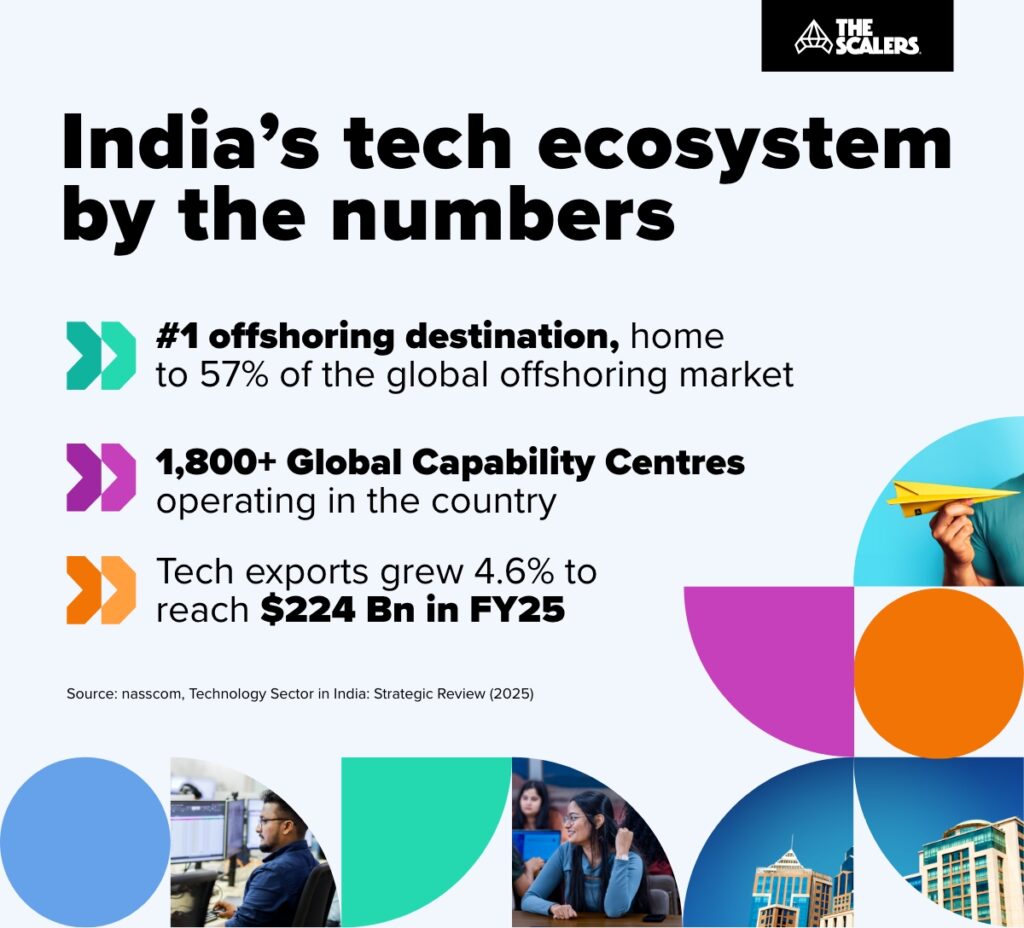
- Indian engineers have the in-demand, niche programming skills that tech leaders most seek. According to the Nasscom Technology Sector in India: Strategic Review – 2025, the country has ~60,000 AI professionals, 13,000 GenAI professionals, and 500,000 cloud professionals.
- Around 1.5 million engineers graduate from top tech universities in India yearly. The nation is projected to produce 18 million STEM graduates by 2027.
- Top Indian developers have a high level of English, which makes it very easy for them to work with international businesses. As per the EF English Proficiency Index, India is more proficient than other countries with large engineering populations, such as Mexico, Brazil, and Colombia.
Advantages of hiring Indian developers
When you hire Indian programmers through the right model, you’re gaining access to engineers who can (genuinely) move your product forward.
These are the key advantages of hiring Indian developers:
- You get specialists with experience in your industry. India’s talent pool is deep enough that you can find people with the exact skills your business demands and a proven track record working with companies in your sector (e.g., legal tech, FinTech, EdTech…).
- You save money (and still hire top talent). When you offshore to India, you’re saving 25-40% on average engineering costs and accessing the same calibre of talent you’d find at home.
- You enjoy extended development coverage. While your team sleeps, your Indian developers can push forward on critical features. This means issues are resolved overnight, and you wake up to progress rather than bottlenecks.
- You tap into a culture that values problem-solving. Indian engineers are trained through a rigorous education system where analytical thinking and solving complex challenges are core to every engineering curriculum. They don’t just write code to specification, but they also consider edge cases, suggest improvements, and take ownership of outcomes. That mindset is baked into how they approach work.
- You build teams that stay for the long run. Turnover is lower among offshore Indian programmers than among freelancers or contractors. When you hire through the right partner and model, these engineers become an integral part of your company.
Plus, the professionals you hire have extensive experience working with Western companies, so they understand your workflows and your terminology. They speak your language.
For years, there’s been a perception that India is the back office of the world. That’s changed. Today, organisations centre engineering, R&D, and product development roles in the country, not just support functions.
Ryan Chana, Global Head of Advisory at The Scalers, confirms this shift: “There’s clearly been an evolution from thinking of India as a back office location where you just offshore or outsource some non-technical functions. Today, offshore teams make up a huge part of the value chain for a lot of organisations. They’re a core, strategic part of the business.”
What should you consider when hiring Indian programmers?
Before you start hiring Indian programmers, it’s worth stepping back to think about a few factors:
- The hiring and engagement model you choose will define your outcome. This is the single biggest decision you’ll make, and it’s one that many CTOs get wrong early on. You need to decide if you want engineers who complete a project and move on, or people who become part of your product team for the long haul. The answer to that question determines everything (from the quality of candidates you attract to how invested they’ll be in your business).
- Think beyond the tech stack and consider your scaling roadmap. Listing the programming languages and frameworks you need is the easy part. The harder question is what kind of team you’re building over the next 12 to 18 months. You might need senior engineers who can architect solutions independently, or you might be better off with mid-level developers who’ll grow under your tech lead. Your product might also require domain expertise, say, someone who’s built payment systems before, if you’re in FinTech. These decisions shape who you hire and how fast you can scale.
- IP and information security can’t be an afterthought. Your engineers will have access to your source code, internal systems, and potentially sensitive customer data. Before you hire anyone, make sure there are airtight contracts in place covering intellectual property ownership and confidentiality. If you’re subject to GDPR or similar regulations, you’ll also need to ensure your own compliance framework accounts for an offshore team. A trusted offshore partner will have robust security protocols, certifications, and NDAs already baked into their operations, but you need to verify that.
- Define how your team will communicate (don’t leave it to chance). Many horror stories about hiring programmers in India come down to one thing: nobody sets expectations upfront. Before your first engineer starts, decide how many overlapping hours your team will work synchronously, or commit to an async-first approach. Also, agree on tooling and establish how decisions get documented. The engineers you hire will adapt quickly if they know what “good communication” looks like in your organisation, but they can’t read your mind.
- Think about infrastructure and where your team will work. This one gets overlooked sometimes. Your developers can work in a dedicated office or scattered across shared co-working spaces, and the difference matters. The physical setup affects productivity and, in general, your team’s well-being.
We’ll dig deeper into each of these throughout this guide. But even if you don’t read any further, keeping these five things front of mind will put you ahead of most CTOs hiring Indian programmers.
Where to find software developers in India
One of the first questions you must ask yourself before building your team in India is where you want to establish operations, given that not every city in the country has the same talent pool or strengths.
There are many tech hubs you can pull talent from, but Bangalore, Hyderabad, and Pune are among the most popular destinations:
- Bangalore is called ‘The Silicon Valley of Asia’, and for good reason. The city has over 2 million software developers, more than any other location in India. It’s home to major R&D centres from Google, Microsoft, and Amazon, as well as thousands of startups. If you need specialists in data engineering, cloud architecture, or developers with a background in specific sectors, such as FinTech, Bangalore has the deepest pool of talent.
- Hyderabad comes in second for IT talent. The city has around 900,000 tech professionals and hosts major offices from Facebook, Apple, and Qualcomm.
- Pune is growing fast as a go-to hub for building tech teams. The city has a younger developer population, which means you can hire talented engineers early in their careers and grow them into senior roles.
Weighing all options, Bangalore is often considered the ideal IT offshoring destination. It’s especially attractive for organisations looking for a vast talent pool and a place where they can set up teams with just a few engineers and scale to hundreds as their needs grow.
How to hire Indian programmers step-by-step
To hire Indian programmers the right way, you need a structured approach that gets you engineers who deliver real value to your business.
Here’s a step-by-step process you can follow:
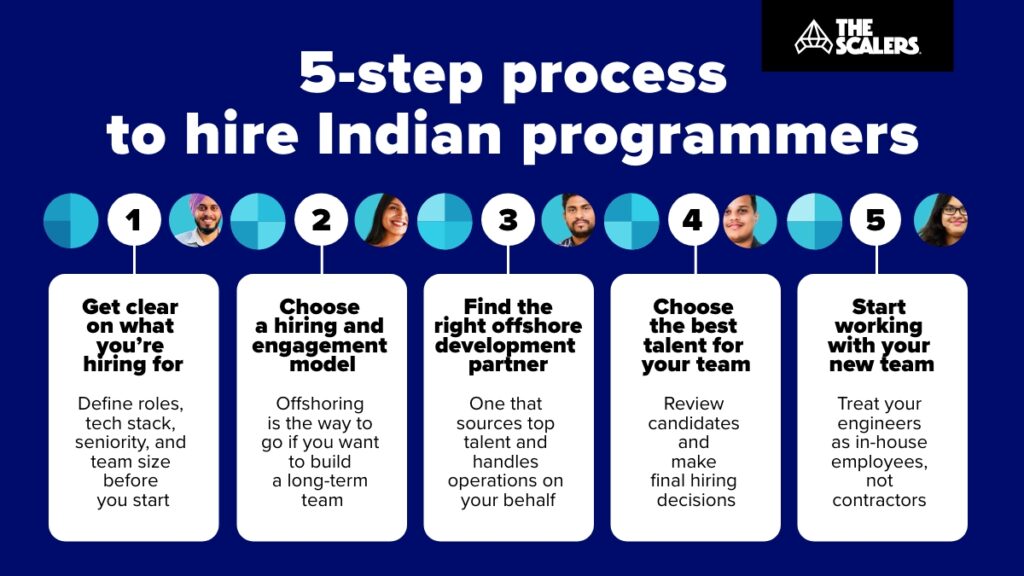
Step 1: Get clear on what you’re hiring for
Before hiring, nail down your requirements. What roles are you filling? What tech stack do your engineers need to know? What seniority level makes sense to you, junior developers you can train up, or senior engineers who can hit the ground running?
Think about team size too. Are you starting with two developers, or do you need a full scrum team of eight from day one?
Write all this down. A doc with role descriptions, must-have skills, and your timeline will save you weeks of back-and-forth later.
Step 2: Choose a hiring and engagement model
Most companies hiring Indian programmers consider two models: outsourcing or offshoring. They sound similar, but they’re different in practice:
- Outsourcing means hiring engineers to complete a task or project. You define the scope, they deliver the work, and the relationship ends when the project wraps up. This model works best for short-term needs or when you need to ship something fast, but it’s not ideal for long-term product development.
- Offshoring involves building a team with engineers who work exclusively for your company. They follow your processes and are invested in your product’s success because it’s their only focus. This is the model you want if you’re thinking about scaling your engineering capacity over time.
The quality difference between the two models is notable. Outsourced developers treat your project like one task on a long to-do list, whereas offshore developers’ only commitment is to your product.
Step 3: Find the right offshore development partner
Considering you’ve chosen to use offshoring as your model for hiring Indian developers, the next step is to find an offshore development partner that can help you source the talent you need.
A trusted partner handles everything on the ground: recruitment, onboarding, HR, legal compliance, office infrastructure, equipment, and ongoing team engagement. You focus on building your product, while they ensure your team has everything they need to do their jobs.
Here’s what to look for when evaluating partners:
- Ask about their recruitment process. How many candidates do they screen per role? What’s their acceptance rate? How long does it take from kickoff to first hire?
- Check their track record. Do they have case studies showing they’ve built teams for companies like yours?
- Talk to companies they’ve worked with. Not the testimonials on their website, but actual conversations with CTOs who’ve worked with them for a year or more. Ask about communication, quality of hires, and whether engineers actually stick around.
- Look at their operational setup, too. Do they provide dedicated office space for your team, or are your engineers scattered across co-working spaces? What kind of support do they offer – is there someone managing team engagement and retention, or are you on your own once the engineers are hired?
Pricing matters, but it shouldn’t be your only consideration. The ‘cheapest’ partner usually cuts corners somewhere – recruitment, office quality, or ongoing support. You’ll pay for those shortcuts later, in the form of turnover and productivity issues.
Step 4: Choose the best talent for your team
In most cases, you can participate in the recruitment process that your offshore partner kicks off right from the beginning. However, your partner’s goal is to save you time. They may interview over 100 candidates per role and will recommend that you get involved at the final stage of the process.
Here’s something you should know: you have the final say in choosing the right engineers for your team from the talent your partner sources.
Your partner will send you candidate profiles, CVs, technical assessment results, and interview notes from their team. Review these in detail. Look for engineers who’ve worked on products similar to yours, have the right technical depth, and communicate clearly during their screening calls.
Use your time to assess judgment, communication, and cultural fit. Those are the things that make or break remote collaboration.
Step 5: Start working with your new team!
Once you’ve chosen the best engineers for your team, your partner will handle onboarding and get everything up and running.
Now it’s your turn to lead.
Manage your new engineers the same way you do with your in-house team. Set priorities, review code, ship features, and iterate based on feedback. The key is treating your offshore engineers as full members of your product team, not remote contractors working in a silo.
Most importantly, help them understand the “why” behind what you’re building, not just the “what.” Engineers who grasp the bigger picture contribute better ideas and catch issues before they ship.
Challenges you may face when hiring Indian engineers
We’ve covered the good in hiring Indian talent, but, as with anything, there are a few challenges you need to be aware of before you make the move:
- The first is the geographical distance and time zone differences. It’s not easy to monitor your team’s performance when they are five, six or more hours ahead of your headquarters. Communication problems and cultural differences may arise.
- Another challenge you may face when hiring Indian talent is quality assurance. Your engineers can be world-class, but are they following best programming practices? Is there sufficient control in place to maintain high standards?
- Security is also a vital aspect to consider. Just think that your tech team will have access to your organisation’s internal systems and confidential information! If your engineers don’t adhere to strict security protocols, your intellectual property and sensitive data may be in danger.
These aren’t dealbreakers, but they’re real considerations. The good news? A reliable offshore partner with a proven track record can help you navigate all three.
The Scalers’ unique (and proven) offshore model solves CTO headaches
If you’ve read this far, chances are you’re looking for an offshore partner that can help you hire Indian developers.
At The Scalers, we’ve built an offshore model that sources top engineering talent in Bangalore and addresses the most common issues CTOs and other tech leaders face when hiring Indian programmers:
- We solve geographical distance and time zone differences by assigning each partner a dedicated Partner Success Manager, Learning and Development Manager, and Chief Happiness Officer. These professionals care for your team, train them in soft skills and communication, and motivate them daily. With their support, we ensure your operations run smoothly while maintaining your unique company culture.
- We solve quality assurance by handpicking the most talented professionals in Bangalore. These engineers are trained to follow engineering best practices and guidelines.
- We hold official security certifications, including ISO 9001 and ISO 27001. Our infrastructure and information security protocols ensure peace of mind for you, including for those in regulated sectors.
See what allpay, a UK FinTech, has to say about how we helped them overcome talent shortages and modernise their payment platform:
All the due diligence was taken care of by The Scalers based on our requirements, thanks to the 7-step recruitment process that The Scalers undertake. All we had to do was have the final chat with the hiring manager at allpay.
Ready to hire Indian programmers? Fill out this form, and one of our senior executives will contact you promptly.
In the meantime, we invite you to watch a one-minute video that explains why companies should hire engineers in India.
FAQs
Hiring Indian programmers is typically 30% to 40% less expensive than what you would pay at home. For locations with particularly high costs, such as the US, the savings might even range from 40% to 50%.
Indian programmers are skilled in a wide range of technologies, from web and mobile development to advanced areas such as AI, cloud computing, and more. Many excel in popular programming languages like Java, Python, and JavaScript. You’ll also find specialists in niche areas like Rust, Go, and blockchain development.
Partnering with a reputable offshore development company with a rigorous vetting process is the best way to ensure quality. A reliable provider handles recruitment, onboarding, and ongoing management so you get top-tier engineers who meet your standards and fit your culture.
Yes! Indian programmers are used to working with global teams and can easily adapt to your time zone and work schedules. For example, a team in Bangalore can provide real-time collaboration for Europe while overlapping with US hours.
From the date of kick-off, it generally takes between 45 to 60 days.
Absolutely. Many companies start with just a few engineers and later expand to teams of 100+ specialists, as their needs grow. At The Scalers, we always advocate beginning with a SCRUM team (5 to 7 people). However, we understand that partners may prefer to test our capabilities before scaling a full team, so we are happy to start with 2 engineers and scale from there as needed over time.
While this is rare, we have a process in place for situations where a developer isn’t meeting expectations. If you’re not satisfied with a developer’s performance, our People & Culture team initiates a structured Performance Improvement Plan with clear goals for the next 30 days. If improvements aren’t met, we proceed with termination and already have replacement recruitment underway to avoid disruption. In severe cases, we can bypass the PIP and terminate immediately.
Build Your Team,
Not Just a Contract
With The Scalers’ offshore dedicated development team, you get engineers who join your workflow for the long run. Grow steadily, stay flexible, and work with people who care about the product as much as you do.