





- Offshore development services in India give you access to 5.8M+ tech professionals at 25-40% lower costs than Western markets.
- You can choose among three solutions based on your business needs: a development team extension, a dedicated development team, or an offshore development centre.
- When you engage an offshore development company, they follow six steps: discovery and deep dive, solution design, contract negotiation, partner onboarding, recruitment and engineer onboarding, and invoicing.
- To hire offshore developers successfully, you need to: define your technical requirements, choose the right hiring and engagement model, select the right partner, pick the best engineers, and manage them like your local team.
Hiring offshore developers can (dramatically) accelerate product delivery, but can also create serious operational and communication risks if done wrong. We’ve heard stories from our current partners and many other business executives that confirm this…
This guide is for you if you’re evaluating offshore development services in India and looking to build a team with minimal risk. You’ll learn how to hire the right talent, see real-world examples of companies that succeeded with offshore teams, and understand how the right offshore development company and model can make all the difference.
What are offshore development services?
Offshore development services let you hire dedicated teams in other countries to handle software development, application maintenance, quality assurance, and similar technical work.
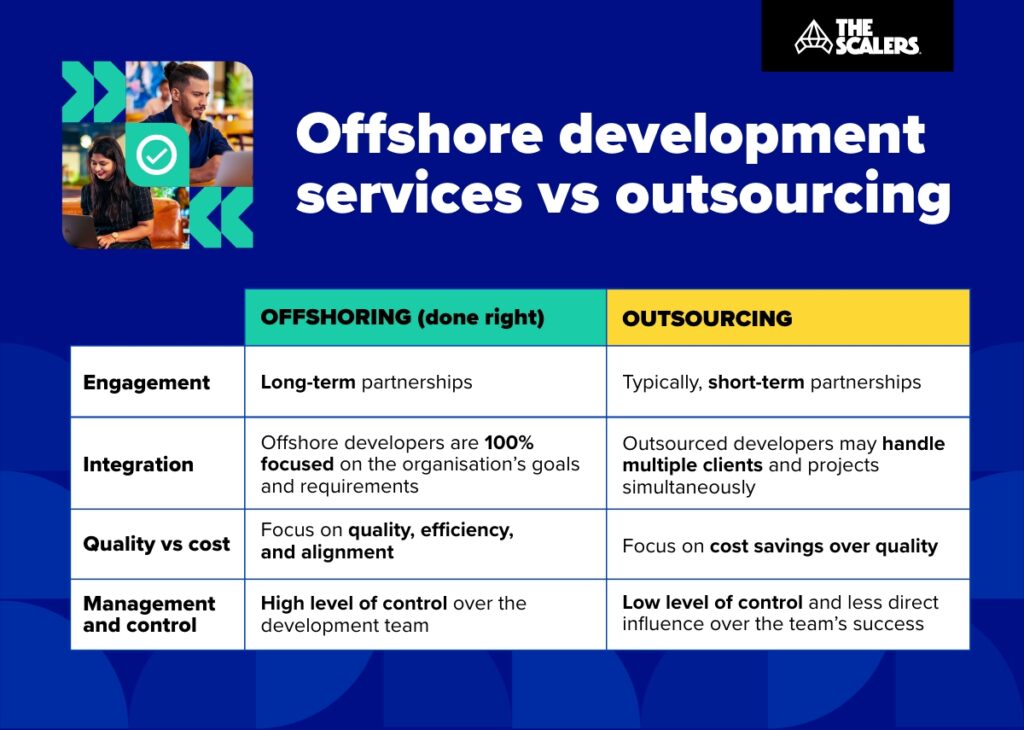
For example, a US company can hire an offshore team of 5 data engineers in India to build and maintain complex analytics systems. It’s important to note that offshore software development isn’t the same as outsourcing, nearshore software development or onshore software development. The infographic below highlights the key differences between offshoring and outsourcing, the two most popular and flexible engagement models to build tech teams.
Why India is the #1 destination for offshore development services
India is arguably the preferred destination for US and European organisations to build and scale offshore teams. These are some of the reasons that justify its popularity:
Access to 5.8M+ professionals and Bangalore’s tech ecosystem
You read it in the title. India has a massive talent pool, with 5.8 million professionals working in the tech industry. The country has the second-largest developer population in the world (behind China) and is set to become the largest dev community on GitHub, reaching 57.5 million developers by 2030!
Many of the best Indian engineers live and work in Bangalore, a city known as the Silicon Valley of Asia. This tech hub ranks among the world’s top 10 startup ecosystems, year in, year out, and is home to R&D centres of global giants such as Google, Microsoft, Amazon, Apple, and Meta.
Cost-effectiveness: Save up to 25-40% vs. Western markets
It’s no surprise that most organisations build offshore teams to reduce development costs. The salaries that senior software engineers command in cities like New York, San Francisco, and London are prohibitive for small and mid-sized businesses looking to scale their operations.
As reported in our article on how much companies save offshoring to India, tech leaders can expect savings of 25-40% on the total costs per engineer compared to in-house teams. All while hiring specialists with equivalent skills, or even more experience in in-demand and emerging technologies than they would find in their home countries.
English proficiency and cultural compatibility with Western companies
Indian engineers have a very high English proficiency and thrive in tech and business contexts. As per the EF English Proficiency Index 2025, India has higher English proficiency than other popular offshoring destinations like Colombia, Mexico, or Brazil.
Thanks to the country’s offshoring boom over the past 10-15 years, hiring an Indian developer today means adding a professional to your team with many years of experience working with Western companies. They know exactly how to collaborate with a business in the US and Europe and understand cultural nuances.
Established infrastructure and vibrant tech hubs
If there’s a word that can describe India’s tech infrastructure, it’s ‘dynamic.’ There’s a feeling in the air that something new is happening every day and that the big thing is yet to happen.
Cities like the aforementioned Bangalore, which became an ideal IT offshoring destination after decades of favourable government initiatives and business development, are a perfect example of this. As Deepak Arunachalam, COO and Partner at The Scalers, puts it when talking about Bangalore’s industrial ecosystem: “This is something you can’t replicate overnight.”
EY’s Future of GCCs in India report highlights the scale at which India’s tech infrastructure continues to grow. By 2030, the country is projected to have over 2,500 Global Capability Centres (GCCs), contributing more than $100 billion to the economy. Growth is expected to continue at a pace, with an estimated 115 new GCCs launched each year and a workforce of 4.5 million professionals.
Offshore software development service solutions in India
You are convinced that India can offer what you’re looking for. Now, what are the offshore software development service solutions you can find in the country?
At The Scalers, we offer our partners three solutions tailored to their business needs: a development team extension, a dedicated development team, and an offshore development centre (ODC).
This is how these three solutions work in practice, as described by our Director of Partner Success, Adith Khan.
Development team extension
- What it is: Adding skilled developers to an existing team.
- Best for: Filling skill gaps, adding capacity quickly, and specific expertise.
- Number of professionals: ~2-6 engineers.
This is where most of our partners start.
Generally, organisations that go offshore already have an in-house team and come to India looking for a few engineers with a very particular skill set. They may already have an architect or product manager working at their headquarters in the US or Europe, along with a few devs, and now they want to add more engineers to that team.
Our development team extension solution lets them hire the right talent by sourcing top talent from Bangalore’s rich software engineering pool.
Dedicated development team
- What it is: Building a new offshore development team from scratch.
- Best for: Accelerating product and software delivery.
- Number of professionals: ~8-15 engineers.
There’s a second group of companies that want to build a team from the ground up. They know what they want to do, but don’t have the right people to deliver.
The solution that better suits them is to set up a dedicated software development team from scratch, ready to start making an impact from day one and 100% committed to the company’s success.
Offshore development centre (ODC)
- What it is: A dedicated facility that brings together skilled engineers, data scientists, business analysts, and other specialists under one roof.
- Best for: Long-term scalability and product development.
- Number of professionals: ~25-100+ specialists.
ODCs are the preferred offshore development service solution for partners that have worked with us the longest.
Some of them had started by expanding their team or building a team from scratch, saw their engineers contributing to their success, and came to us saying, “We hired 10 devs, and it went really well, but now we want 20-25 new roles in the next 6-9 months.”
These companies don’t need just software engineers, but also business analysts, data scientists, and other positions that don’t (necessarily) require programming skills. For these types of requirements, we always recommend building an offshore development centre that allows them to scale their teams as needed.
How offshore development services work in India: The complete process
You just learned the main solutions you can choose from when offshoring to India. Now, let’s talk about how offshore development services work in the country by showing the step-by-step process we follow at The Scalers right after a company contacts us.
Again, the word to our Director of Partner Success, Adith Khan.
Step 1: Discovery & deep dive
When a company approaches us seeking offshore development services, we kick off what we call the discovery and deep-dive phase. Put simply, we meet with you to understand your needs.
This is the moment when we talk about the problems you’re facing, what you want to solve, the tools you need, and the processes that should be implemented. For example, you might tell us that you need to build a tech team to support long-term development, with the vision of releasing and maintaining a flagship product, but can’t find that type of talent at home.
Step 2: Solution
This step is self-descriptive: we find the right solution for you.
Once we know where your company stands and what your unique requirements are, we come back to you with what we consider will work best to fulfil your goals. That might be extending your existing tech team with a few engineers or building a dedicated offshore software development team from scratch.
Step 3: Contract negotiation and signing
Here’s when we agree on the terms of the contract and lay the foundation for a long-term partnership. You can expect discussions about aspects such as:
- Scope of the engagement and the number of engineers.
- Duration, pricing, and payment terms.
- Confidentiality, IP, and legal agreements.
This step ensures that both sides are aligned and we’re all set for a smooth collaboration moving forward.
Step 4: Partner onboarding
After negotiating the contract, we onboard your company to The Scalers. You’ll meet your dedicated Partner Success Manager (PSM) and Chief Happiness Officer (CHO). The latter is responsible for the well-being of your engineers and makes sure they have all they need to thrive at their jobs.
We also walk you through the recruitment process and explain how it works. We set up communication channels between all stakeholders, schedule regular check-ins, reconfirm job descriptions to ensure everything is clear, and provide access to shared emails and OneTeam, the platform you’ll use to manage your new team.
Apart from that, we set the expectations for candidates during interviews. You won’t need to worry, as we always highlight your company’s selling points and introduce your projects to the engineers, explaining all the necessary details.
Step 5: Recruitment
Now is when we start sourcing and screening candidates to find the best fit for your team. We share the shortlisted candidates with you for interview rounds so you can meet only those who match your needs.
At the same time, we set up the office, equipment, and tools for your offshore software development team.
Step 6: Engineer onboarding
Once hired, your team integrates with your existing processes, tools, and workflows, and you manage them directly, just like they were part of your local team.
After your engineers join, we handle the invoicing process on a simple, predictable monthly basis. You’ve already agreed on pricing for each position, so there are no surprises. Invoicing is clear, transparent, and aligned with your agreed terms, so you can focus on managing your team and projects without worrying about administrative details.
Real-world success stories: Companies that have thrived with Indian offshore teams
There’s no better way to showcase offshore development services in India than highlighting real examples of organisations that have achieved success setting up teams there.
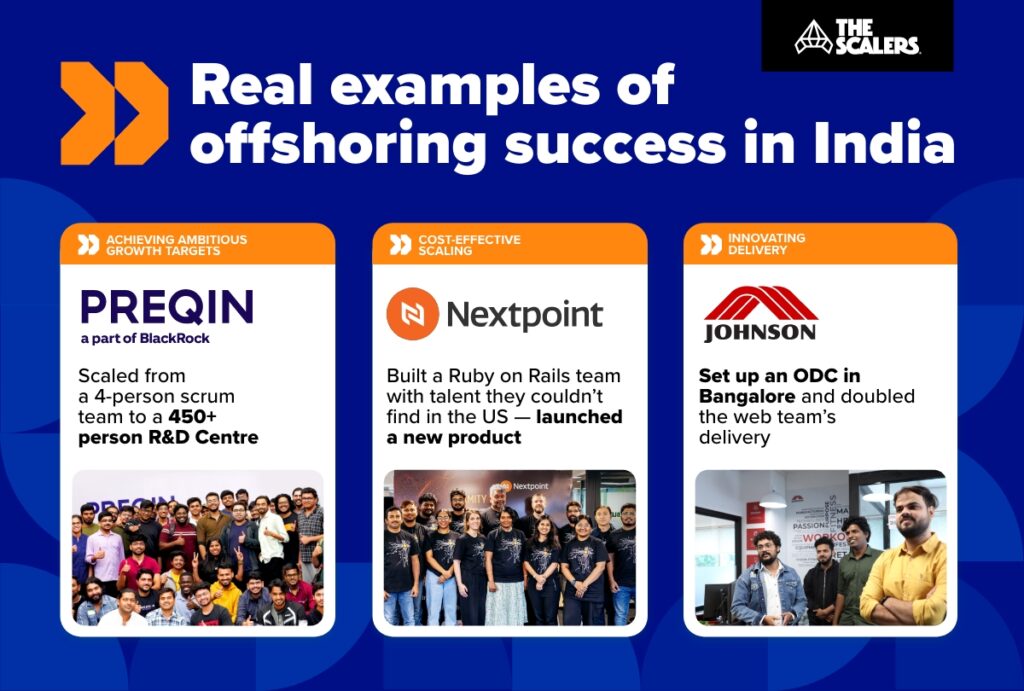
Let’s take a look at these three stories: Preqin, a UK FinTech; Nextpoint, a legal US firm; and Johson Health Tech, a Taiwanese fitness/manufacturing company.
Preqin scaled to a 450+ R&D Centre
Preqin had big plans in 2018. The company wanted to build Preqin Pro, its new flagship product, but couldn’t find the specialists it needed in London. It had tried offshoring to India in the past, but didn’t get the expected results. That’s when Preqin’s leadership team contacted us and established what eventually became a long-lasting partnership.
We started small with one scrum team of four developers. Within two months, they were up and running. The quality impressed Preqin’s leadership so much that they added two more teams to work on Preqin Pro. Six months in, they’d hit 50 engineers.
By 2020, the firm launched Preqin Pro and already had 100+ offshore engineers in India. In 2023, its Bangalore R&D Centre had grown to 450+ people across development, data operations, IT support, and other functions, all working in a dedicated 5,400 m² office we helped them set up.
Preqin’s team has driven continuous development of its flagship product, handled complex projects, delivered mission-critical software solutions, and has become essential to its position as a global leader in alternative assets data.
The company has now established a legal entity in India, assisted by us.
Nextpoint built a top Ruby on Rails team
Nextpoint faced a problem many growing businesses have: it couldn’t find the right Ruby on Rails developers in the US. When it did find candidates, bigger tech companies with deeper pockets would poach them. It had tried offshore partners before, but the quality and cultural fit were off.
After visiting our Bangalore office in person (leadership was sceptical at first), Nextpoint’s CEO and VP of Engineering decided to move forward with us. We sourced hundreds of candidates and presented only the top prospects. Five months later, the company had a core team of six Ruby on Rails developers and one AWS specialist, all with the right skills and cultural alignment.
Engineers onboarded faster than Nextpoint’s US counterparts and contributed to its groundbreaking serverless product launch. Within eight months, Nextpoint expanded its team to 11 specialists, adding a scrum master and more developers. Its Bangalore team has become the go-to location for new technical hires and currently stands at 13 people.
Johnson Health Tech accelerated delivery with an ODC
Johnson Health Tech (JHT) needed to bridge the gap between its North American and Taiwanese teams. The company wanted 24/7 development capabilities but wasn’t sure an offshore team could meet its high-quality standards. After evaluating several options, JHT decided to partner with The Scalers.
We started with three web engineers as a test. The team’s performance exceeded expectations. Engineers went beyond their requirements, impressing the Head of Web Development enough to expand to a full scrum team.
JHT’s offshore team has doubled web delivery output and enabled true round-the-clock development across time zones. By 2024, JHT had an 8-engineer ODC covering web and software development, and today it has expanded to 12 members.
How to hire offshore developers in India
Now the ball is in your court. We’ve covered everything you need to know about offshore development services in India, including the step-by-step process from an offshore partner’s perspective – how it actually works when you partner with a company like The Scalers.
What you’ll read below is your action checklist: the steps companies like yours should take when hiring offshore software developers in India, especially if you’re not sure where or how to start.
We wrote a comprehensive guide to hiring Indian programmers, which we recommend reading, but here’s a summary of the most important steps.
Define your technical requirements and team size
Get clear on what you’re hiring. Ask yourself questions like:
- Which roles do you need to fill?
- What skills are essential? Specific programming languages, frameworks, or technical expertise in areas such as cloud migration?
- What level of seniority do you need?
Document everything: role descriptions, must-have vs. nice-to-have skills, your timeline, and budget range.
Choose the right hiring and engagement model
This may sound obvious, but many tech leaders confuse offshoring with outsourcing. We want to make it clear that if you want to build a long-term team 100% dedicated to your success, you should stick with offshoring.
Why? Well, outsourcing means hiring developers for a specific project or task. This works for short-term needs but isn’t ideal for ongoing product development.
With offshoring, you can build a dedicated team that works exclusively for your company. These engineers follow your processes and are fully invested in your product because it’s their only focus.
Partner with the right offshore development company in India
Once you’ve decided on offshoring, find an offshore development company that can handle everything on the ground: recruitment, HR, legal compliance, office setup, equipment, and ongoing team engagement. You focus on building products while they ensure your team has what they need.
Also, evaluate their recruitment process, operational setup, and a proven track record of successful long-term partnerships. Don’t choose based on price alone. The cheapest option usually cuts corners somewhere else, and you’ll pay for those shortcuts later through turnover and productivity issues.
Pick the best talent
Offshore partners source candidates, but you choose who joins your team.
You’ll receive a list of shortlisted candidates. When you interview finalists, focus on problem-solving approach, communication skills, and cultural alignment. Pay attention to engineers who’ve worked on products similar to yours and can communicate clearly.
Work with your team
Now is your turn to lead. Manage your offshore development team like you would if they were working in your headquarters: assign work, review deliverables, and iterate together. Treat them as core team members.
It’s essential you recognise and address common challenges such as communication barriers, which are frequent in offshore software development. Establishing clear communication protocols can help mitigate these challenges and ensure smoother collaboration.
Most importantly, share context. Engineers who understand your product vision and business goals contribute stronger ideas and solve problems better.
Why The Scalers is your ideal offshore software development partner in India
If you’ve made it this far in the article, you’re probably weighing your options for building an offshore software development team in India. The choice of partner matters more than most people realise, and can be the difference between setting up a world-class team and one that becomes a liability down the line.
At The Scalers, we’ve built 130+ offshore teams in Bangalore over the past decade, leveraging our technical expertise and experience across various industries through a unique, proven offshore model.
Every offshore software development team we build is culturally aligned with our partners from day one. This avoids some of the most common offshore pitfalls that slow teams down or create friction later on.Our partners have highlighted in Clutch, where we have a 4.9/5 rating, how deeply we care about engineer engagement, with some achieving 0% attrition rates and others reporting 25% cost reductions.
We had tried outsourcing but it always cost us more time and money to fix than it saved. The Scalers are completely different. The engineers they found work the exact same as our local ones and they have created our culture there.
Ready to build your offshore development team in Bangalore? Contact us to discuss your specific needs, and one of our senior executives will promptly get back to you for a discovery call.
FAQs
The main benefits are access to specialised talent you can’t find locally, significant cost savings (typically 40-50% compared to Western markets), and the ability to scale your team quickly as your business grows.
At The Scalers, we follow a rigorous 7-step recruitment process to ensure you only work with developers who fit both your technical requirements and company culture. By the time engineers join your team, they understand your business, your expectations, and have the skills needed to contribute immediately.
Absolutely. You can start with a small team extension of 3-5 engineers and scale to an offshore development centre with 100+ specialists. Our model is built to scale with you.
Build Your Team,
Not Just a Contract
With The Scalers’ offshore dedicated development team, you get engineers who join your workflow for the long run. Grow steadily, stay flexible, and work with people who care about the product as much as you do.