






Offshoring is not simply about reducing development costs. It is a strategic way to access global talent, increase engineering capacity, and build long-term capabilities. The key to success is knowing when to offshore, understanding the risks, and choosing an engagement model that matches your business maturity and growth ambitions – that’s why we crafted this article.
Offshoring challenges rarely stem from distance alone. More often, they come down to poor partner choices, weak management, communication gaps, and unclear ownership. Here is how leading teams tackle these risks:
- Communication: Establish clear reporting structures, overlapping hours, and effortless daily collaboration processes.
- Cultural integration: Embed offshore engineers into your core company values, daily routines, and strategic goals.
- Quality control: Maintain high engineering standards with rigorous code reviews, automated testing, and clear delivery ownership.
- Cost transparency: Look at the total cost of operations and value delivered, rather than developer salaries alone.
- Security: Protect your assets with strict access controls, robust IP agreements, and compliance standards like ISO/IEC 27001.
- Team management: Treat offshore engineers as an extension of your in-house team, fully plugged into leadership and product roadmaps.
It’s hard to know whether going offshore is the right move for your business without seeing real-life examples firsthand.
In this article, we break down the pros and cons of offshoring, drawing from our experience building 145+ tech teams over the past decade, and share stories of organisations that have made it work.
What is offshoring? A quick definition
Offshoring means delegating processes or moving operations to a foreign country. For example, a US or European company can set up an offshore development team in India to design, build, and maintain software.
Organisations that go offshore cite difficulties in finding the right professionals in their local or neighbouring regions. By hiring in countries with large pools of tech talent and lower living costs, businesses access top engineers while enjoying cost-effective operations.
While cost savings often come up in initial conversations with companies considering offshoring, Ryan Chana, Global Head of Advisory at The Scalers, notes that it’s rarely the sole driver: “Cost efficiency is always an underlined priority, but it’s often driven by another requirement which may be growth or capacity-related, like the need for product development.”
Is offshoring the same as outsourcing?
Some business leaders confuse offshoring and outsourcing, but they’re different hiring models. Offshoring is an excellent solution for companies looking for a fully dedicated team that adds long-term value to their product, while outsourcing is ideal for short-term, temporary tasks.
If you want to know more about the differences between both approaches to building teams, we’ve written an article comparing outsourcing vs offshoring that you may find helpful.
Offshoring pros and cons (when done right)
Most guides you’ll find on offshoring advantages and disadvantages reach the same conclusion: you can cut costs when setting up your tech team, but you may face cultural and communication barriers.
While this isn’t entirely wrong, there’s a more optimal way of going offshore that doesn’t require compromising on collaboration and alignment.
The pros and cons list we’re sharing is based on this model – the same one we’ve used at The Scalers to build high-performing, resilient offshore teams for industry leaders.
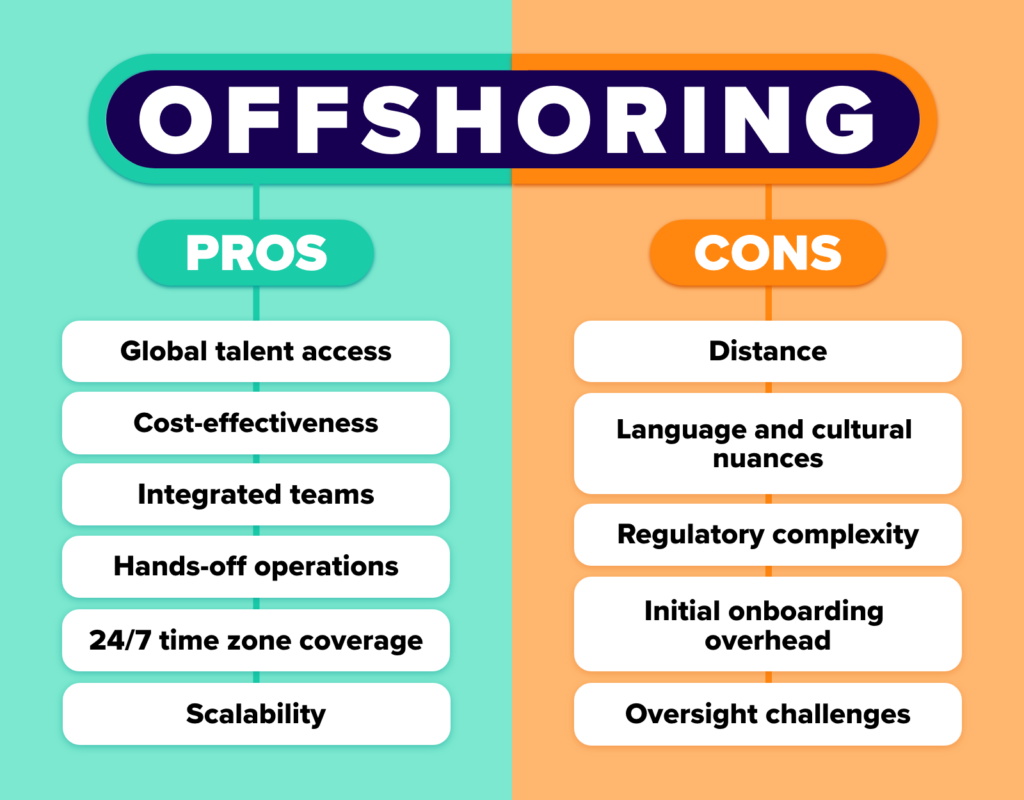
Pros of offshoring
Access to the best talent, globally
One of the main benefits of offshore teams is hiring highly specialised professionals in countries with large talent pools like India, Poland, and Colombia. These regions boast engineers with niche technical skills and extensive experience working with Western organisations. For instance, tech giants like Microsoft, Meta, and Amazon have Research and Development Centres (R&D Centres) in Bangalore, a city that produces 90,000 new engineers yearly. But offshoring advantages aren’t exclusive to the biggest names in the industry. Through this business strategy, any organisation can gain access to top developers with the most in-demand skills on the market.
Let’s say you work at a FinTech and need to extend your team with 5-7 Quant developers with experience in building CVA Sensitivities models. With the help of the right offshore development partner, you can hire the best engineers available in talent-rich locations.
Cost-effectiveness
Offshore developers are more cost-effective than engineers in Western countries due to factors like their region’s lower cost of living and professional rates.
According to Levels.fyi, a software engineer in the US earns an average monthly salary of $11,000 to $22,500, while an equivalent engineer in a top offshoring destination like India earns between $1,500 to $5,700.
That’s a staggering difference, considering value for money. Offshore engineers not only command lower salaries but often match or exceed the technical skills of their US and European counterparts. Plus, they bring the soft skills that matter the most to CTOs and business leaders, like creative thinking and problem-solving.
Some business leaders worry that lower costs signal lower quality, but Ryan Chana challenges this assumption: “It doesn’t really mean it’s lower quality. You’re paying less because it fits another market. The talent is the same whether an engineer stays in India or goes to the US, all that’s changing is the location. When you change location, you adapt to local wages.”
Chana adds that concerns about cheap offshoring often stem from “horror stories from many years ago with companies having disastrous outcomes when outsourcing,” but emphasizes the universal truth: “You get what you pay for, and that can happen locally too.”
Integrated and culturally aligned teams
Offshoring ensures effective collaboration and integration between organisations and their newly formed tech teams. This means that your offshore team is 100% aligned with your business, with your DNA instilled in it.
Your offshore engineers work as your in-house team, share your goals and vision, and use the same communication channels as the rest of your company. It’s a model that fosters cultural and strategic alignment, giving clear visibility and control over your offshore team’s progress.
Hands-off operations
With the right offshore partner, you won’t have to worry about setting up operations: they will do all the heavy lifting while you focus on your product and start working with your team.
Contrary to models like nearshoring or onshoring, offshoring means building a team in a country where you likely have limited knowledge of legal and business-related matters.
When you have a partner on the ground setting up IT, HR, infrastructure, and other tasks for you, you can rest assured that even if you’re located thousands of miles away from your team, everything runs smoothly. From hiring and onboarding to administration, your offshore development company has you covered – including security and data protection.
Tech decision-makers are often concerned about moving operations elsewhere because of the risk of data loss and leaks. Exposure to security threats is one of the most common problems with outsourcing and is wrongly associated with offshoring.
Some of the best offshore development companies are accredited with official security certifications confirming their compliance with industry regulations (i.e., ISO/IEC 27001).
A reliable partner builds offshore teams that follow the same strict security practices as your in-house team to protect sensitive information and maintain data integrity. With security fully handled, you get peace of mind knowing your data is in safe hands.
Time zone coverage
One of the most overlooked advantages of offshoring is the ability to cover multiple time zones. Ironically, a benefit that stems from what many see as a challenge: collaborating with teams in different time zones, sometimes with a 7–10+ hour difference.
This setup ensures that development continues around the clock, keeping projects moving even when your in-house team is offline. “Around-the-clock development is especially beneficial for global companies with ambitious development plans that need people continually shipping code and delivering on the roadmap”, says Ryan Chana.
For example, imagine your company is scaling its platform and needs a dedicated offshore team to support ongoing development. While your in-house engineers wrap up their day, your offshore team picks up where they left off, pushing updates, resolving issues, and accelerating feature releases without delays.
Having a few hours of overlap between your offshore team and your headquarters resulted in higher productivity and potentially a faster time to market.
Scalability and flexibility
Offshoring allows you to build and extend your development team whenever needed.
Let’s say you want to scale your offshore engineering team with 15 more developers due to business growth. Your customers demand new and better products, and your headquartered team can’t handle more work.
Once you specify your needs to your offshore partner, they’ll kick off a recruitment process to find the right talent. If you want to add more engineers to your team in a few months or years, your offshore partner will always be ready to help.
Cons of offshoring
Geographical distance
If you want to share the same or similar time zone as your development team and regularly travel to visit them, offshoring might not be ideal for your business.
However, a reliable offshore partner is responsible for minimising the disadvantages of collaborating with a team located in a distant country. For example, they may organise periodic workations for businesses to work face-to-face with their offshore team. While geographical distance is a deal breaker for some organisations considering offshoring, for others, it’s an added value: you get the best tech talent, period, irrespective of the distance from HQ, because talent quality is the priority.
Ryan Chana explains: “It may seem a bit scary for small businesses that don’t have a mature engineering function, but for companies that have good processes and the right collaboration tools in place, distance shouldn’t be a concern.”
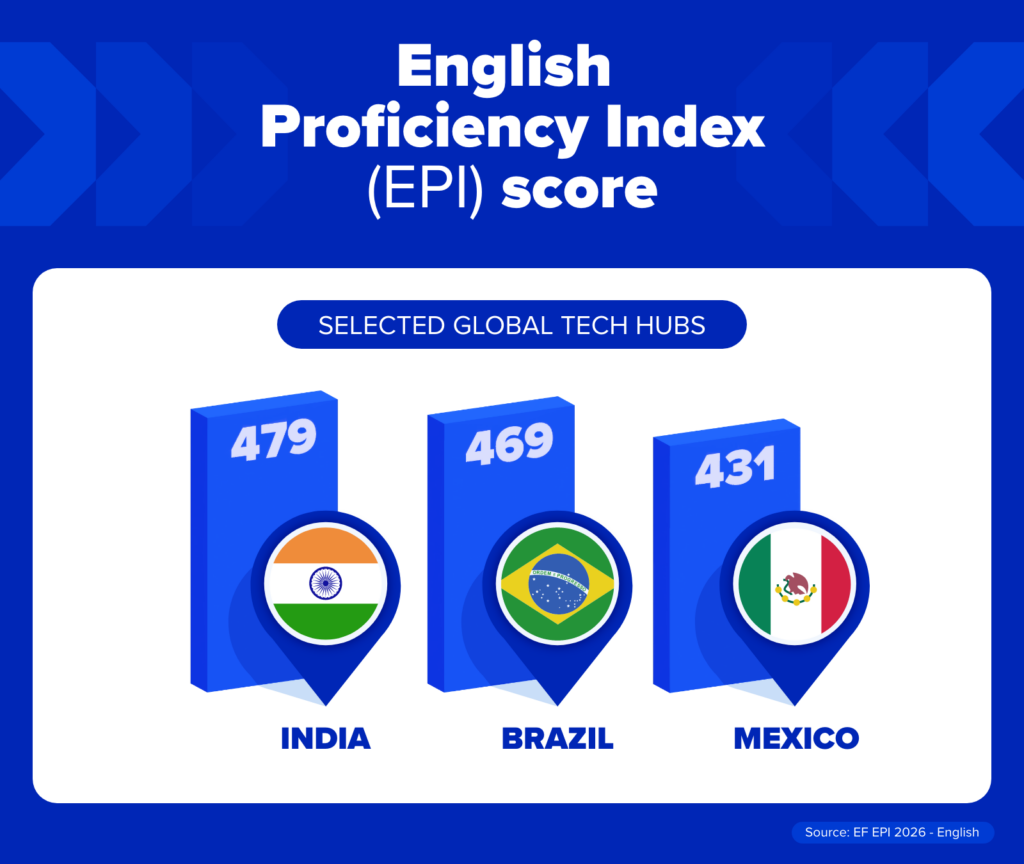
See India. The Asian country is a renowned tech hub producing some of the most talented developers in the world year in and year out. These engineers study in top universities and have niche programming skills, not to mention high English proficiency.
Language nuances
Even when offshore software engineering teams exhibit high proficiency in English, subtle linguistic nuances, regional idioms, and culturally distinct communication norms – such as indirect feedback loops – can create friction during high-velocity sprint cycles. In modern remote engineering environments, these subtle misalignments can lead to misinterpretations of complex user stories, edge-case requirements, or urgent architectural trade-offs. Structured communication frameworks and context-sharing mechanisms are essential for maintaining alignment across distributed teams.
Regulatory complexity
Operating engineering operations across international boundaries entails navigating intricate cross-border compliance environments. Enterprise organizations must address differing employment and labor mandates, intellectual property protections, data sovereignty requirements, and privacy standards such as GDPR. Establishing robust legal oversight and leveraging experienced local compliance partners is crucial to ensuring seamless multi-jurisdictional operations.
Initial onboarding overhead
Integrating a newly formed offshore team requires upfront investments of time and resources from in-house leadership. Beyond setting up developer infrastructure and security protocols, effective integration relies on comprehensive domain knowledge transfer and structured workflows – often enhanced by modern AI-driven onboarding documentation and knowledge management systems.
Oversight challenges
Maintaining strong organizational alignment, team morale, and consistent code quality across globally distributed engineering organizations demands disciplined governance frameworks. Engineering leaders must implement structured agile processes, objective performance tracking, and deliberate culture-building practices to bridge physical separation and keep the offshore team fully integrated with the broader product vision.
When to choose offshoring?
Let’s move beyond the usual argument of when you want to save money.
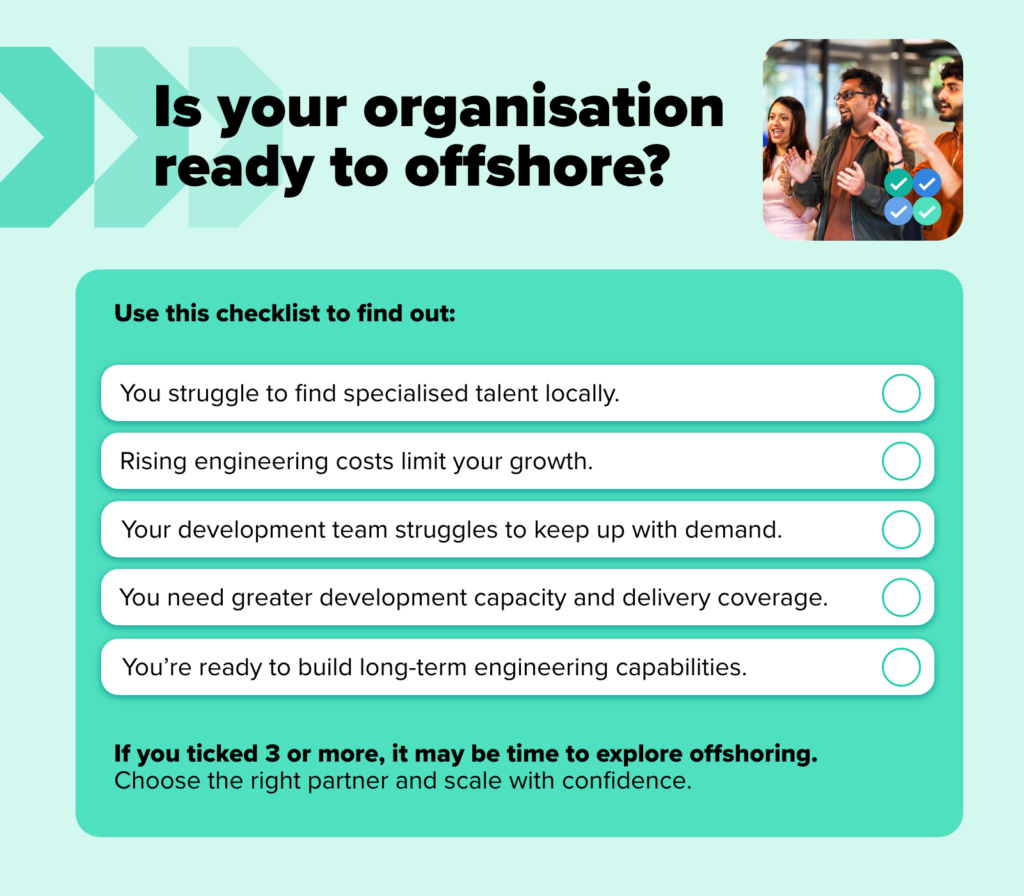
Offshoring makes strategic sense when a business has identifiable capacity, talent, or operational challenges that its domestic market cannot efficiently address. Specifically:
- When local talent shortages slow down growth. Consider offshoring if you cannot find the specialized engineers you need locally, or if recruitment takes too long to meet business demands.
- When engineering costs limit scalability. Do local hiring costs make it difficult to expand engineering capacity without putting pressure on budgets? Offshoring is your answer.
- When development backlogs affect delivery. Take action if your existing team cannot keep up with product development, technical debt, modernization, or innovation priorities.
- When you need continuous development capabilities. A GCC might be your go-to choice if you want to extend development hours, improve operational coverage, and support global product delivery.
- When you need long-term engineering capabilities. A permanent offshore presence will serve as an extension of your core technology organisation.
Which offshoring model fits your stage?
Choose the model that best fits your current needs. As your offshore ambitions grow, your engagement model can evolve from adding individual capabilities to establishing a fully integrated global operation.
| Model | Phase | Business objective | Best fit | Learn more |
|---|---|---|---|---|
| Team Extension Model | Initial expansion phase | Scale bandwidth by embedding developers into existing setup. | Companies with a mature internal technology function. | How does the development team extension support your business? |
| Dedicated Development Team | Constructing core capability | Full-time offshore unit committed exclusively to your roadmap. | Growing organisations with continuous software development needs. | All you need to know about dedicated team development. |
| Offshore Development Centre (ODC) | Establishing a dedicated engineering hub | Technical operations with leadership, squads, and operational support. | Scaling enterprises requiring ongoing multi-team R&D delivery. | Discover ODC as your new R&D hub. |
| Global Capability Centre (GCC) | Building a strategic international footprint | Integrated global organization across engineering, product, finance, and HR. | Large enterprises executing long-term global growth initiatives. | Secure long-lasting teams—from engineering, through HR, up to accounting. |
| Build-Operate-Transfer (BOT) | Transitioning to complete internal control | Incubate and scale a centre before acquiring total ownership. | Mature organisations intending to ultimately own their foreign subsidiary. | Build the team. Set the operations. Transfer all directly into your organisation. |
How to choose the right offshoring location
After evaluating the pros and cons of offshoring, you may have decided to hire offshore developers to support your company’s long-term growth. The question is: how to find the ideal destination for setting up your new team?
There are a few factors that you should consider before making a final choice:
- Time zone alignment. Decide whether you need overlapping hours for real-time collaboration or prefer continuous development where your offshore team works while your local team rests. Both approaches have their benefits depending on your workflow.
- Language proficiency. Look for locations where English or your business language is widely spoken. Strong communication skills are non-negotiable for collaboration between your headquartered and offshore teams.
- Cultural compatibility. Every region has different work styles and business practices. A good cultural match makes integration smoother and partnerships stronger, something your offshore partner should prioritise.
- Talent availability. Different countries excel in different areas. India offers massive pools of engineers with expertise in in-demand programming languages, while other regions may have strengths in other domains.
- Value for money. Offshoring lets you hire top engineers at lower costs than local markets. Focus on destinations where salary savings don’t compromise quality and where talent rivals or surpasses what you’d find at home.
Real insights: How industry leaders leverage offshoring
Enough with the theory. Let’s get into some real-world examples of how industry leaders make the most of offshoring advantages, featuring APAC-based food and beverages company My Muscle Chef and UK FinTech Preqin.
My Muscle Chef grows while keeping cost-effective operations
My Muscle Chef, Australia’s leading provider of fresh ready-made meals and functional foods, needed top talent to keep up with its growth. The company had tried outsourcing and offshoring in the past but didn’t get the expected results.
All until its leadership team found an offshoring model with unique advantages that allowed them to build an elite engineering team and scale operations cost-effectively.
With a model that (finally) worked for its unique needs, My Muscle Chef increased development velocity and achieved a 50% boost in development and a 70% reduction in tech debt.
To me, typical offshoring or outsourcing is usually about cost saving and not scaling. I wanted a properly distributed model where we have a true team where I have control over all my engineers and can scale when needed. We now have this in place and it is working very well.
Preqin builds a culturally aligned offshore team
Preqin, the leading data solutions provider in alternative investments, needed to extend its engineering capacity to meet project demands and thought offshoring could be the perfect solution for their needs.
However, its existing partner lacked transparency, offering little control over development while charging hidden costs.
The organisation’s leadership team wanted to hire engineers fully aligned with Preqin’s culture, vision, and mission. And that’s exactly what they got thanks to the best offshore model to build dedicated teams in Bangalore. By 2023, Preqin had scaled from a 4-person scrum team in 2018 to a 450+ person R&D Centre.
Beyond just software development, the offshore team evolved into a full-fledged R&D hub, including finance and HR roles and becoming an integral part of Preqin’s global operations. Despite being thousands of miles away from the company’s headquarters in London, Preqin’s Bangalore team was pivotal to the release of Preqin Pro, a new flagship product.
How can The Scalers help you overcome offshoring challenges?
Before partnering with The Scalers, Preqin and My Muscle Chef faced similar challenges:
- Struggling with past outsourcing/offshoring models that didn’t deliver.
- Lacking local talent, particularly in specialist roles.
- Finding engineers fully aligned with their culture and business long-term goals.
- Ensuring their offshore team is truly integrated with their business.
- Needing a model that prioritised quality over cost-cutting.
- Wanting full control over their engineers with the flexibility to scale.
- Scaling engineering capacity fast.
These might also be some of the hurdles you face when considering building an offshore team. If that’s the case, we’re here to help.
At The Scalers, we’ve assisted organisations of all sizes and industries in setting up operations in Bangalore, India. Known as ‘The Silicon Valley of Asia’, the city is home to 2 million software developers specialising in niche programming skills.
Our unique and proven offshore model sources the top 1% of Indian engineering talent and provides businesses with the professionals they need to grow their products.
We build fully dedicated, culturally aligned teams, ensuring engineers feel part of our partners’ in-house teams. Our approach to engineer satisfaction keeps attrition below 15%, far lower than the 34% average in Indian offshore firms.
If you want to know more about our offshore model and how we can help you build, extend, and scale a world-class tech team, fill out this form. One of our senior executives will contact you promptly!
In summary
Offshoring isn’t just a cost-cutting strategy, as some business leaders still believe. When done right, this hiring and engagement model offers advantages that far outweigh the drawbacks.
It all comes down to finding the right model. As we’ve seen, companies like My Muscle Chef struggled with offshoring at first, but once they found a better approach to building teams, success followed.
FAQs
Yes. Offshoring allows emerging businesses and early-stage companies to connect with highly skilled software engineers, optimize operational expenses, and grow efficiently without bearing the high overhead of domestic hiring, adding value when:
- Domestic hiring is cost-prohibitive or sluggish. Local talent acquisition moves too slowly or strains budgets.
- Niche technical expertise is required. You need specialised engineering capabilities to build and scale software products.
- Continuous product development is essential. Your roadmap demands ongoing engineering velocity and capacity.
- Scaling requires budget efficiency. You want to expand development bandwidth while avoiding the financial footprint of expanded local operations.
That said, going offshore may not yield optimal results for tiny, short-term assignments. Upfront investments in sourcing, integration, and management can negate cost advantages when only hiring one or two developers temporarily.
At The Scalers, our proven approach focuses on starting with a focused dedicated unit that seamlessly expands alongside your operational growth. While setup can launch with as few as two developers, we typically recommend a core team of 5–7 engineers to establish strong momentum from day one.
Companies can typically save 30–40% on software development costs by offshoring to India, although actual savings depend on the technology stack, seniority, location, and engagement model. Savings come from more than lower developer salaries. They can also include:
- Lower recruitment and employment costs.
- Reduced office space and infrastructure expenses.
- Lower HR, administrative, and operational overhead.
- Access to specialised talent without expensive local recruitment.
An important consideration is the total cost of ownership, not just the hourly developer rate. Recruitment, onboarding, management, infrastructure, and employee retention all affect final ROI.
Ultimately, offshore teams should operate under the same security policies and governance standards as your in-house engineering teams. Protecting intellectual property and sensitive business data starts with choosing a partner with strong security practices, clear legal agreements, and controlled access to company systems. In short: protect your IP and data through NDAs and clear ownership agreements, role-based access controls, data encryption, ISO 27001 certification, employee background checks, and continuous security monitoring.
Time zone differences can become a productivity advantage when teams establish clear communication practices and overlapping working hours. India operates on GMT+5:30 (IST) throughout the year and does not observe daylight saving time. Rather than treating time differences as a barrier, businesses can use them to extend development coverage and maintain delivery momentum.
Bangalore is one of the world’s leading technology hubs. The Silicon Valley of India offers a large pool of skilled engineers, competitive costs and a well-established IT ecosystem. Its real advantage goes beyond cost savings: businesses get the talent, infrastructure and ecosystem needed to build and scale long-term engineering teams
Reducing attrition starts with treating offshore employees as an integral part of your organisation. The Scaler’s retention model combines dedicated HR support, performance management, engagement initiatives, and a Chief Happiness Officer focused on employee satisfaction. Our average attrition rate sits around 11% (while the Indian IT industry benchmark is ~30–35%).
The underlying principle is simple: when offshore engineers feel valued, connected to the business, and invested in its success, they are more likely to stay.
The most common services organisations offshore are tech-related solutions like software development and IT consulting. Other services include customer support, finance & accounting, HR, content creation, manufacturing, data processing, R&D, sales, and supply chain management.
Companies go offshore to find the professionals they can’t find at home. By hiring specialists in countries like India, they leverage large talent pools and enjoy cost-effective operations.
Yes, offshoring is an excellent model for businesses seeking a long-term solution to scale their operations. Unlike other models like outsourcing, offshoring prioritises long-term partnerships by building dedicated teams that fully integrate with organisations, align with their goals, and grow alongside them.
Industries that benefit the most from offshoring include financial services, retail and ecommerce, and MarTech, where businesses build scalable platforms and manage complex data operations. Other industries like healthcare, manufacturing, and logistics also leverage offshoring to optimise processes.
The main compliance challenges involve navigating different regulatory frameworks, data protection laws, and industry regulations in foreign countries. A reliable offshore partner handles these complexities on the ground and holds certifications like ISO/IEC 27001 to ensure compliance with local and international standards.
With offshore software development, you can build dedicated teams that fully integrate into your in-house operations, regardless of location. Your offshore engineers work as part of your core team, sharing the same goals, communication channels, and company culture.
Build Your Team,
Not Just a Contract
With The Scalers’ offshore dedicated development team, you get engineers who join your workflow for the long run. Grow steadily, stay flexible, and work with people who care about the product as much as you do.