





- Offshoring involves building a tech team overseas with specialised talent you can’t find locally.
- Key benefits include cost savings, speed to scale, and access to high-quality specialised talent.
- Offshore software development costs less than local hiring, with recruitment, taxes, infrastructure, and HR bundled into a single monthly fee (when partnering with the right offshore development company).
- A big part of your success when offshoring depends on finding a trusted offshore partner.
- India is the #1 offshoring destination due to its vast talent pool and a mature tech ecosystem.
Wondering what offshore software development is all about? Then, this article is for you.
Drawing on our extensive experience building over 130 offshore tech teams over the past 10+ years, we’ve compiled what we’ve learned into this comprehensive guide. It includes a clear definition of what offshore software development (really) is and its benefits, guidance on where to build a dedicated team with skilled developers, industry trends, and other valuable insights.
We hope you find it helpful!
What is offshore software development?
Offshore software development refers to the process of setting up an overseas tech team to design, build, and maintain software. This team is meant to support a business’s long-term growth and ongoing operations.
Organisations that go offshore typically do so to hire professionals with in-demand or niche skills they can’t find in their home countries, often turning to talent-rich locations such as India.
The large pool of elite engineers they can access in tech hubs like Bangalore, plus the ability to scale quickly and cost-effectively, allows them to increase their output and improve their technical expertise without significant inconvenience or expense.
Most businesses opt to extend their delivery capacity by adding a few engineers to existing teams, while others prefer to build a dedicated development team from scratch. For those who need specialists beyond software engineers and plan to scale teams into the hundreds, establishing an offshore development centre is the best approach.
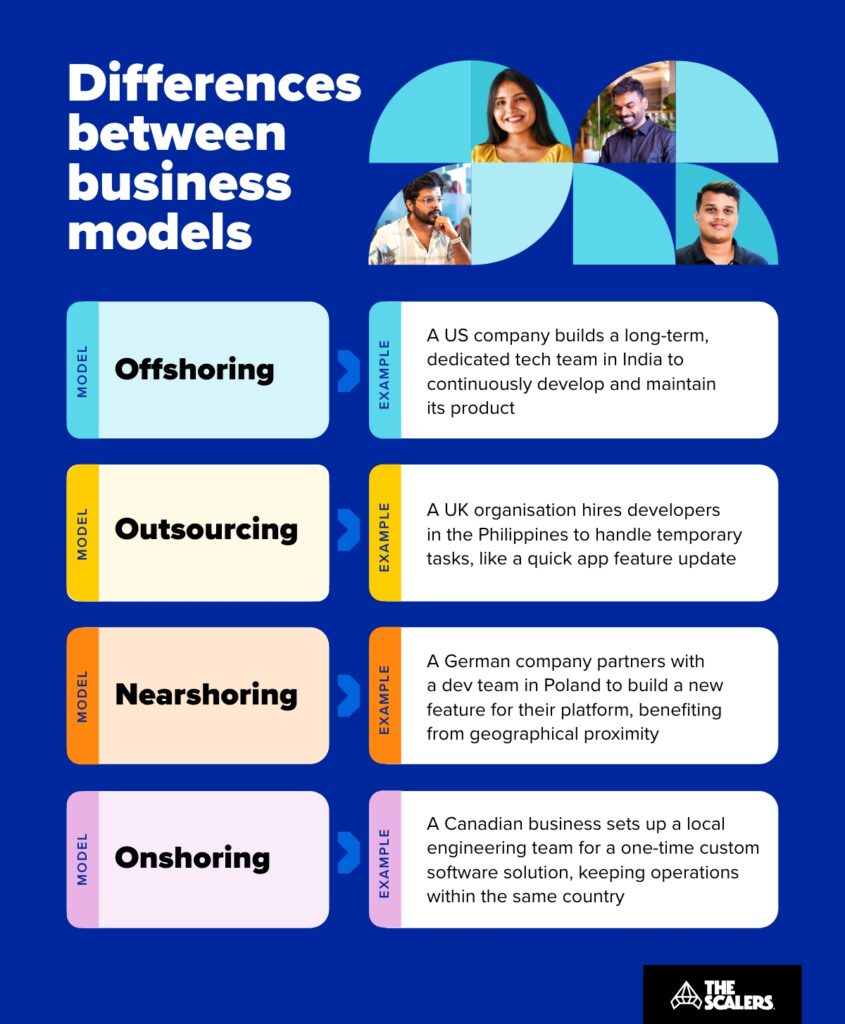
What is the difference between offshoring, outsourcing, nearshoring, and onshoring?
Despite its similarities, offshoring isn’t the same as outsourcing, nearshoring, and onshoring:
- Offshoring means building long-term tech teams with specialised talent in another country, generally thousands of miles away from an organisation’s headquarters.
- Outsourcing involves hiring professionals from a third party for (generally) temporary or short-term work.
- Nearshoring consists of setting up a development team in a neighbouring country with minimal time zone differences.
- Onshoring refers to establishing a tech team locally to ensure direct oversight over execution and real-time collaboration.
Check out our article on the key differences between offshoring, outsourcing, nearshoring and onshoring for an in-depth analysis of the topic.
Is offshore software development ethical?
Absolutely. Offshore software development is ethical when done responsibly.
“As long as you treat people fairly, embed them successfully into your team and pay them well, there’s nothing unethical about it,” says OJ Budak, Senior Associate at The Scalers.
Countries like India produce highly skilled engineers who work in modern, well-equipped environments that prioritise employee well-being and fair wages, adjusted for local living costs. “Bangalore wouldn’t be Bangalore if offshoring wasn’t ethical. Over ten thousand companies offshore to India, including some of the world’s most successful such as Apple, Meta, Google, Microsoft. The reason why? Well it delivers on scale, talent and cost efficiency at a global standard”, highlights OJ.
However, you should watch out for companies that prioritise cheap labor costs over people. If your offshore vendor can’t clearly explain how much of what you pay goes directly to the engineer, that’s when you know something’s off.
If you’re still doubting whether offshoring is ethical, check out our guide on the ethics of offshoring for a deeper analysis.
What are the benefits of offshore development?
Offshore software development offers numerous advantages to companies of all sizes, from startups to major corporations. These are its five key benefits:
Accessing top talent
When offshoring, organisations can tap into global top talent, regardless of location. For companies headquartered in the US, UK, or other Western regions, building an offshore team is an excellent solution to the scarcity of specialised professionals in their countries.
Indeed, the U.S. Bureau of Labor Statistics predicts demand for nearly 130,000 developer positions annually for software developers, QA analysts, and testers between 2024 and 2034, a level of demand that many companies already struggle to meet due to talent shortages.
That’s not a problem in popular offshore destinations like India. The Asian nation has a talent pool of 5.8 million professionals and produces 1.5 million engineering graduates yearly, ready to embark on professional careers and build software for international organisations.
Getting great value for money
Offshore software development is a hiring and engagement model known for its cost-effectiveness. Organisations that go offshore not only reduce operational costs but also hire high-quality talent for a fraction of what they’d pay in their home countries.
For example, if a CTO wants to expand their tech team with a software engineer in San Francisco, they’d need to pay a median annual salary of $272,000. The same specialist in India commands a median salary of $31,800, nearly nine times lower.
Scaling quickly
Some of the best offshore development companies offer flexible cooperation models that allow organisations to build and scale engineering teams on demand.
Let’s say you are a tech leader and set up a dedicated development team of five engineers. After a few months, your business grows, and you need more developers to design a new product and meet your customer expectations.
That’s where your offshore development partner comes in. You just need to agree with them on how many engineers you need to scale your team, and they’ll start looking for the best talent available.
Reducing technical debt
Technical debt is a major concern for CTOs and an issue that’s very hard to manage once it accumulates over time.
According to recent research by CAST, companies and governments would need to spend 61 billion workdays in software development time to ‘pay off’ the technical debt they’ve accrued over the past four decades. Yes, it’s that bad.
Building an offshore development team can help you tackle technical debt without putting your product roadmap on hold by expanding your overall capacity.
With a larger, integrated team, you can work on fixing underlying issues and delivering new features simultaneously. Your offshore developers get embedded into your workflow, understand your codebase, and contribute across the board. You’re no longer stuck choosing between stability and innovation. You get both.
Focusing on core business activities
A reliable offshore software development company handles recruitment, administration, payroll, and other processes for its partners, giving them peace of mind.
And there’s nothing like the security of having a partner business leaders can trust while they prioritise other crucial aspects of their organisations.
When a firm decides to go offshore, its leadership team gets time to focus on core business activities, interact with potential clients, and expand its offering. In the meantime, their offshore partner handles hiring, onboarding, and engaging top developers, among other time-consuming tasks.
Working with The Scalers has enabled us to scale a really high-performing quality, quality team. They’ve been able to take a lot of the load off us, taking on the business function, the HR function, the recruitment function, to enable us to really spend our time building quality software and collecting quality data.
Want to know more? Read our guide on the top 10 offshore development benefits, in which Adith Khan, Partner Success Manager at The Scalers, analyses in depth the advantages that offshoring can offer to your business.
What are the challenges of offshore development?
Not everything was going to look ideal when offshoring, right?
Compared to building onshore teams, offshore dev teams offer greater cost efficiency and access to top talent, but they can also present unique management challenges. You must be aware of some of the potential friction points when building your new team:
Time zone differences and geographical distance
This is one of the main drawbacks of offshore software development. We want to be transparent here: if you really want to have a team in your time zone and close to your home country for logistical reasons, then offshoring might not be for you.
However, if that’s not a priority, we must say this challenge might not be one after all. Let us explain. When you build a team thousands of miles away from your headquarters, you’re accessing a global talent pool, which means hiring those specialists you’ve been searching for months who are unavailable in your local market.
Also, time zone differences can be an advantage, as you gain extended development coverage. This means that once you log off for the day, your offshore team is just getting started, keeping your product moving forward around the clock.
Communication barriers and cultural misalignment
This one’s a classic. Many tech leaders worry that setting up a team in a faraway region means struggling to ‘click’ with offshore engineers due to language gaps or cultural differences that create friction in day-to-day collaboration.
And look, we won’t sugarcoat it. This can happen if you’re working with the wrong offshore partner or hiring in regions where English proficiency is low.
When you build a team with the right offshore development company, they ensure your team is culturally aligned from day one. That means engineers who communicate clearly, understand your business context, and work in ways that mesh with your existing processes.
Quality concerns
Another common fear: Will an offshore team deliver the quality you need? It’s a fair question, especially if you’ve heard horror stories about buggy code.
This can be solved with a rigorous vetting process that assesses candidates’ technical skills, puts them through real coding assessments, and matches them to your specific tech stack and standards.
What are offshore developers, and what do they do?
Offshore software developers are specialised professionals who bring technical expertise that a company may be lacking internally. For example, a FinTech can hire Quant developers via offshoring to build sophisticated risk models and trading algorithms.
Unlike freelancers and contractors hired via outsourcing who juggle multiple clients, offshore developers are fully committed to a single business and work solely for it. They are 100% focused on the company they collaborate with, using the same tools and processes as the headquarters team.
Who should hire offshore developers?
As mentioned earlier in this guide, companies often go offshore to cut costs and access specialised talent they can’t find in their home countries.
But what does that look like in practice? Here are more realistic, specific examples of companies that can solve common business challenges through offshoring:
- Companies with growing tech debt. Businesses drowning in backlogs that need to fix underlying issues without sacrificing feature delivery or user-facing improvements.
- Companies stuck on legacy systems. Organisations with outdated tech stacks that can’t compete anymore and need to build next-gen platforms while keeping current operations running.
- Traditional businesses going digital. Companies moving to digital-first models that lack the in-house technical skills to execute the transformation on their own.
- Regulated industries needing compliance expertise. Firms that require specialists in data protection, GDPR, or industry-specific regulations but can’t find (or afford) those experts locally.
- Companies adopting emerging technologies. Businesses looking to integrate machine learning, generative AI, or other cutting-edge tech but facing talent shortages and unsustainable salary demands.
What roles can you hire offshore?
You can hire for any role through offshoring, from a junior developer to a tech leader. But what’s actually in demand right now?
“At the moment, we’re seeing a lot of companies looking for infrastructure roles, front-end, back-end, QA engineers, data analysts, data engineers, and InfoSec specialists,” says OJ Budak. “The data engineering positions are a whole different conversation, as there’s massive demand there.”
The most common roles organisations hire are:
- Software engineers. Full-stack, backend, frontend, and mobile developers across tech stacks like Java, Python, .NET, React, Node.js, and more.
- Data engineers. Professionals who build and maintain data pipelines, warehouses, and infrastructure to support analytics and AI initiatives.
- DevOps engineers. Experts in CI/CD, cloud infrastructure (AWS, Azure, GCP), containerization, and automation.
- QA engineers. Manual and automated testers who ensure product quality through comprehensive testing strategies.
- Data scientists. Specialists in machine learning, AI, predictive modelling, and advanced analytics.
- Business analysts. Professionals who bridge technical teams and business stakeholders, defining requirements and optimising processes.
Companies also go offshore to fill highly specialised positions that are hard to find locally. “Let’s say you’re a finance SaaS firm looking for implementation consultants with very niche industry knowledge. Those roles are harder to find in places like London or New York than in popular offshoring locations,” Budak explains.
Where to hire offshore developers?
Now that we’ve covered offshore software development, its benefits and challenges, and what offshore developers do, it’s time to list the best regions to hire top tech talent.
Below is a breakdown of the main regions, but we have also prepared an in-depth guide on the top countries for building offshore teams, which you can read to gain a deeper understanding of each location’s strengths.
Asia: India and the Philippines
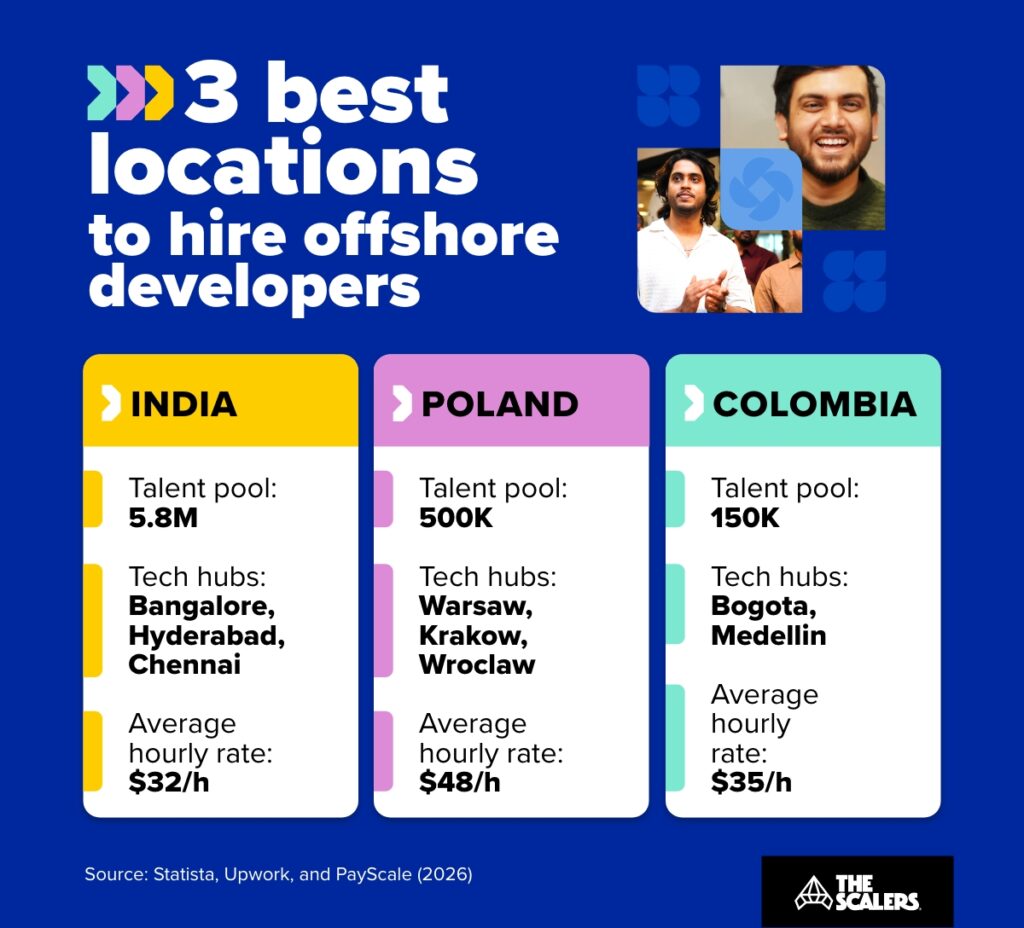
India is a global leader in IT offshoring. Tech hubs like Bangalore support this claim: 90,000 engineers graduate from Bangalore’s universities yearly, and the city is home to over one million software developers.
Given the lower cost of living compared to Western countries, setting up an offshore software development team in India can be a cost-effective option for businesses headquartered in metropolises like New York, London, or Paris.
Another Asian country organisations should consider for offshoring is the Philippines. This tropical archipelago boasts strong English proficiency, with professionals excelling in both technical and business language domains.
However, the country has a far smaller talent pool than India, and professionals are more specialised in support functions such as IT-BPO and customer service. You’d typically pay less to build an engineering team in the Philippines than in India, but you’d also hire less qualified talent.
Eastern Europe: Poland and Romania
Offshoring to Eastern Europe is an attractive business opportunity for US and Western European companies, in particular, for those that require real-time collaboration with their offshore developers. The minimal time zone difference is a plus for better cooperation and reduced communication gaps.
Poland and Romania are among the most popular offshoring destinations in Eastern Europe. Although engineers in these regions are known for delivering high-quality work, the rising cost of living in cities like Warsaw and Krakow in the past few years has made these locations less appealing to businesses seeking cost-effective solutions.
Latin America: Colombia, Mexico, and Argentina
Latin America is becoming an increasingly popular destination for offshore software development. Countries like Colombia, Mexico, and Argentina are investing in infrastructure and technology to attract international companies to invest in the region.
Medellin, Mexico City, and Buenos Aires are evolving into modern tech hubs with a talent pool of expert developers who share a strong cultural affinity with Western organisations.
One downside is that, despite this growth, the infrastructure in Latin America is still less mature than that of more established offshoring destinations like India or Poland, which have decades of experience supporting international tech teams at scale.
How much does offshore software development cost?
The cost of offshore development is lower than hiring locally. Cost cutting is, indeed, one of the major drivers for companies building offshore teams.
Let’s look at offshore development rates by country, what’s included in the total cost per engineer (hiring locally vs. offshoring), and how to calculate ROI when offshoring.
Offshore developer rates by region
To give you a concrete comparison, let’s look at what’s the average annual salary of software engineers in different regions. The below data is taken from specialised salary portal Levels.fyi:
-
- India: $31,800/year.
- Mexico: $41,500/year.
- Poland: $68,200/year.
Note that these offshore developer rates can vary depending on factors such as the engineers’ seniority and industry-specific experience.
What’s included in the total cost per engineer
When you hire locally in the UK or the US, you’re not just paying salary. You’re covering:
- Payroll taxes (around 17% in the UK).
- Pension contributions.
- Health insurance.
- Office space and infrastructure.
- Recruitment costs.
- HR and administrative overhead.
“People don’t always factor in these overhead costs when they compare local vs. offshore hiring. But they make a massive difference,” says OJ Budak.
So if you’re paying a gross salary of £70,000 to a UK-based engineer, you have to add 17% in payroll taxes and about 30% in operational expenses. Costs can add up to £103,000/year.
With an offshore partner like The Scalers, all of that is included in one monthly fee per engineer. Recruitment, salary, taxes, office infrastructure, HR, everything operational, it’s all bundled.
How to calculate ROI on offshore teams
Let’s break down a realistic comparison between hiring locally in the UK versus building an offshore team in India.
UK-based engineer:
- Base salary: £54,000/year.
- Employer costs (25%): £13,500/year.
- Total annual cost: £67,500 (~$85,000).
India offshore engineer (via The Scalers):
- All-in monthly cost: £3,200/month.
- Total annual cost: £38,400 (~$48,000).
That’s a savings of nearly £29,000 per engineer, per year.
If you’re scaling a team of 10 engineers, you’re looking at close to £290,000 in annual savings. Money that can go toward R&D, product development, or simply extending your runway.
For a deeper look at real-world cost breakdowns and ROI calculations, check out our guide on offshoring examples and how much companies really save, where we walk through success stories from companies that have scaled teams offshore.
How to choose the right offshore development company
If you’ve read this far, you’re probably a business leader already interested in building an offshore team, but unsure of how to source, hire, onboard, and engage the right developers. For that purpose, you must collaborate with a reliable offshore development partner.
Follow these five steps to choose the right offshore partner for your business:
- Identify your needs. Define what it’s you’re looking for and set your business goals. If you want to build a development team for long-term collaboration, you should filter your search for partners who specialise in these cooperation models.
- Assess communication. It may sound obvious, but finding a partner who speaks your language is crucial. Search for companies with high English proficiency and any additional languages of your choice, and ensure communication with them is responsive and clear.
- Verify developer quality. Every partner claims to offer the best developers, but most don’t. Check if partners are living up to their promises when offering world-class developers. Ask them where they source talent, which technologies engineers specialise in, and their experience.
- Evaluate security and data protection measures. Cybersecurity is essential for protecting sensitive data and mitigating potential threats. Make sure your partner follows the latest security and privacy guidelines to keep your software safe.
- Do a background check. Learn more about the partners’ experience working with international organisations and see whether they have a proven track record in building and scaling offshore dev teams. Look for testimonials, check their portfolio, and verify if they’re trustworthy.
Want to know more about the process of picking an offshore software development company? Our complete offshore development partner guide includes everything you must consider before making a choice.
How to manage an offshore team
Once your partner builds your team, you might find yourself at a crossroads, trying to figure out how to collaborate with your new engineers.
To manage your offshore software development team, do the following:
Share your mission and vision
Most organisations view their offshore team as a mere execution unit for their development processes. That’s a mistake you can’t afford to make.
You must establish a connection with your offshore team from day one. Start by introducing your organisation’s goals and requirements and share your company’s vision for the future. The more your engineering team knows about your brand, what you want to build, and why, the closer you’ll be to unlocking their full potential (and the more value they’ll provide!).
Bridge the culture gap
You may encounter cultural differences when working with offshore teams. Your goal as a tech leader is to nurture a unified culture of belonging across both locations.
Make your offshore engineers feel appreciated and recognised. Visit them occasionally, conduct icebreaker video calls to get to know each other better, and always be vocal about how you feel about their collaboration.
A Chief Happiness Officer (CHO) plays a pivotal role in this scenario. Some offshore development companies offer their partners a dedicated CHO to foster a safe, appreciative work environment. Their contribution is crucial to building a culturally aligned team that is committed to the organisation’s long-term success.
Communicate effectively
Poor communication costs software teams millions in fixes and delays. While this affects any team (even in-house), it’s even more pronounced with offshore teams. Language and cultural barriers, time zone differences, and physical distance make clear and compelling communication more important than ever.
To avoid misunderstandings and delays, use the following communication channels between your local and offshore teams:
- Email: Share official communications, schedules, and project meeting notes.
- Instant messaging: Platforms like Slack work best for quick clarifications, status updates, and queries.
- Productivity tools: Check task status and performance with Jira, Asana, Basecamp, and other project management tools.
Don’t worry about setting this up. Your offshore partner will handle everything and make it as easy as possible for you.
Offshore software development trends and industry shifts
What are the emerging trends in offshore software development that organisations should watch out for?
Ryan Chana, Global Head of Advisory at The Scalers, has the latest scoop. These are the IT offshoring trends and tech industry shifts he sees having an impact on the way teams will be built in the coming years:
- AI is reshaping team structures. Companies are hiring fewer juniors and building smaller teams of mid to senior engineers who can use AI tools effectively.
- Data engineers are the most in-demand role. Their skills translate directly into AI/ML work, so it’s easier to upskill them than other profiles.
- GCCs are becoming strategic innovation hubs. They’re shifting from cost-cutting operations to driving digital transformation and R&D.
- Cybersecurity talent will be critical. With threats rising and regulations tightening, there’s a massive skills gap that offshore teams can help fill.
- Data sovereignty and AI governance are forcing new compliance frameworks. Organisations need clear policies on which AI tools offshore teams can use and where data gets processed.
Why India leads the offshore development industry
There are many misconceptions about offshore development services in India that organisations often hold, and prevent them from building teams in tech hubs like Bangalore. Concerns about work quality, working conditions, and communication are quite common.
The reality is that these are just outdated assumptions. India is one of the world’s top destinations for offshore development today, with tech giants like Google, Apple, and Amazon, along with small and mid-sized industry leaders, expanding their operations in the country.
Here’s why India dominates the offshore development industry:
- As per Nasscom Technology Sector in India: Strategic Review – 2025, India is home to 57% of the global offshoring market and has 1,800+ Global Capability Centres (GCCs).
- India has an abundant pool of tech talent, with 5.8 million professionals living and working in dynamic tech hubs.
- It has a well-established IT infrastructure, as well as Special Economic Zones (SEZs) and software parks in cities such as Bangalore, Hyderabad, and Chennai.
- Indian engineers possess a strong command of the English language and excel at collaborating with international companies.
- Moving operations to the country is cost-effective, given the lower cost of living and favourable exchange rates.
But none of this matters if you don’t have a trusted partner to help you hire the offshore talent you need.
The Scalers’ offshore development model
At The Scalers, we build offshore teams in Bangalore, ‘The Silicon Valley of Asia.’ With our proven offshore model, we’ve helped companies in multiple sectors build and scale high-performing teams with the right talent. These professionals have been crucial in driving organisations to the top of their industries:
- Preqin, a UK FinTech, scaled to a 450+ person R&D Centre, which was pivotal in launching their new flagship product and accelerating product development.
- Nextpoint, a US legal company, built an 11-person team with the Ruby on Rails engineers they had long been looking for, which helped launch a groundbreaking serverless product.
- Johnson Health Tech, a Taiwanese manufacturing firm, achieved 24-7 development operations thanks to an 8-engineer ODC.
The Scalers are different from other partners I’ve worked with in the past as I don’t have to worry about any of the legal issues; any of the HR issues; any of the IT issues; or any of the building requirements. All I have to do is get up and go at the scale and the speed that I need to.
Do you want to learn more about our unique approach to offshoring and start building your new tech team in India’s tech capital? Drop us a line, and one of our experts will get back to you to help you assess your options and make an informed decision.
FAQs
Any type of company can benefit from offshore software development. From a startup in the finance industry to a mid-sized retail company to a large tech corporation, there’s no limitation on which business can leverage offshoring.
One of the main reasons companies go offshore is to cut costs, but it’s not the only one. Most organisations cite the inability to find the right talent in their home countries as a major driver for building or expanding their current tech teams through offshore software development.
Offshore developers are generally full-time employees, not contract-based professionals. For instance, at The Scalers, we don’t have engineers on a bench. We build teams with specialists who work full-time and are dedicated to our partners’ culture and business outcomes.
Of course! Offshore engineers are fully integrated into your workflow and processes, and they may be more specialised than your in-house team in certain methodologies or workflows. These experiences can also offer new perspectives on solutions you’ve never considered.
India has the second-largest software development talent pool in the world, just behind China. The country has dynamic tech hubs like Bangalore, which is known as one of the top startup ecosystems in the world and home to hundreds of R&D Centres from the greatest brands.
Yes, in India, there are many offshore development companies that offer long-term offshore partnerships. At The Scalers, we’re proud to say we have partners with whom we’ve been working for almost 10 years.
You manage and communicate with your offshore team exactly like you do with the rest of your colleagues. For example, if you normally schedule a daily standup with your local teams, you can do the exact same thing with your offshore team.
Build Your Team,
Not Just a Contract
With The Scalers’ offshore dedicated development team, you get engineers who join your workflow for the long run. Grow steadily, stay flexible, and work with people who care about the product as much as you do.