





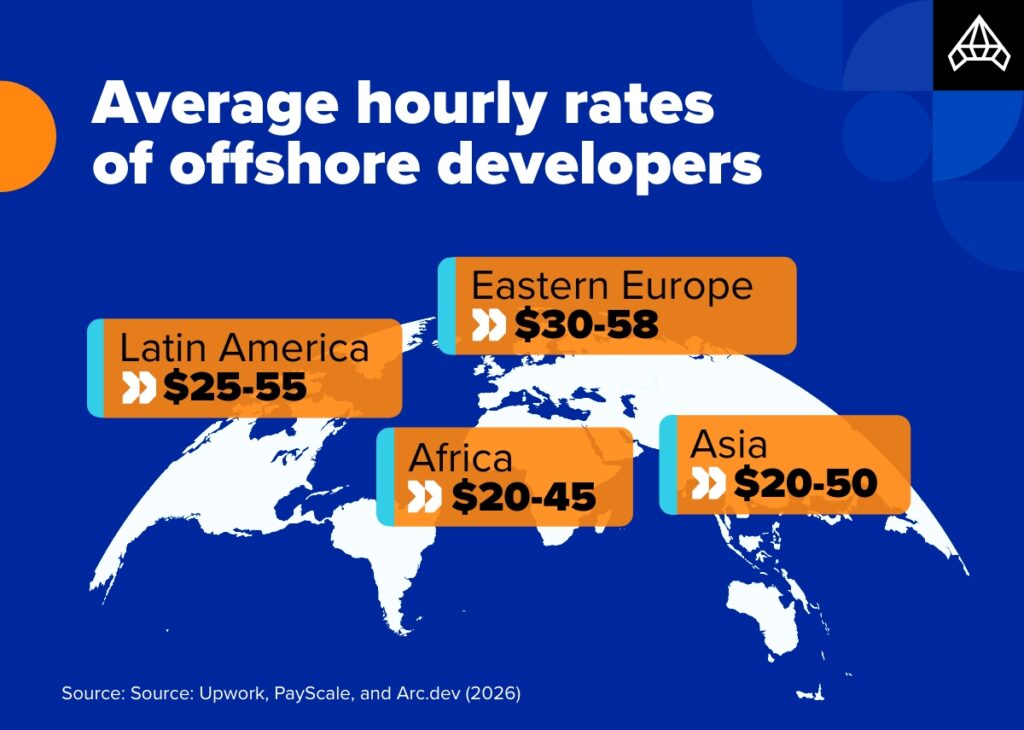
- Offshore software development rates by country vary significantly: Asia ($20-$50/h), Latin America ($25-$55/h), Eastern Europe ($30-$58/h), and Africa ($20-$45/h).
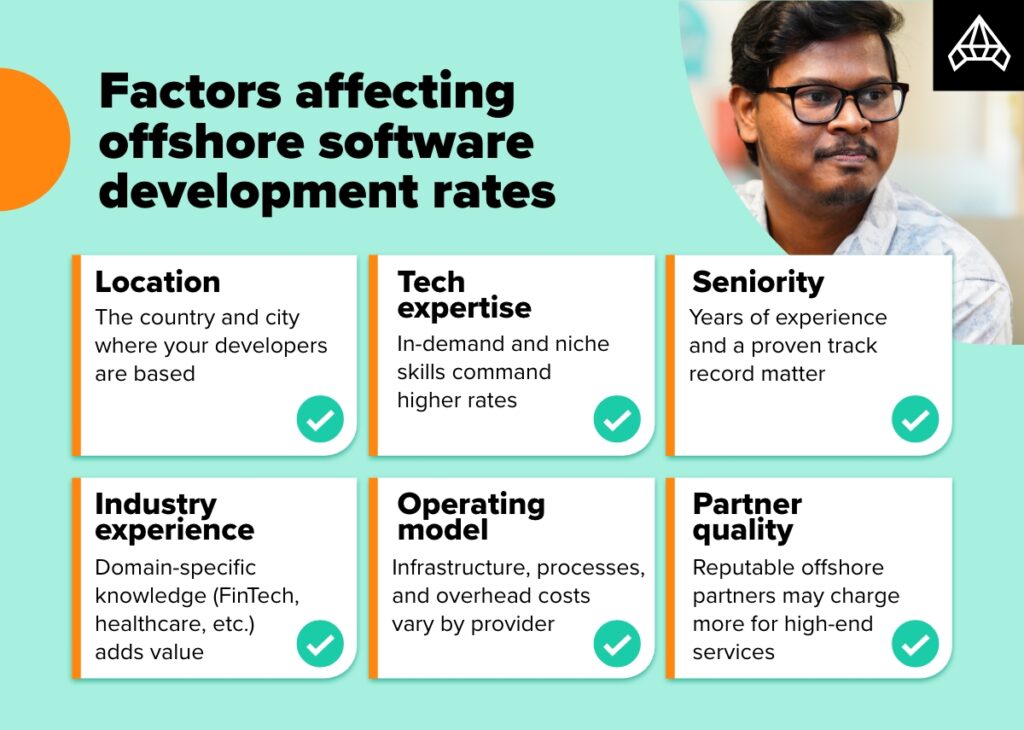
- Six key factors affect offshore development costs: location (country and city), tech expertise, seniority, industry-specific experience, operating model, and your partner’s quality and track record.
- Hidden costs like contract lock-ins, surprise fees, and high turnover can blow up your budget.
- Building dedicated teams with a monthly, all-inclusive fee pricing model delivers greater cost efficiency than hourly or project-based rates.
Cost-cutting is one of the main reasons organisations establish offshore development teams in countries such as India and the Philippines. But what’s the real cost of offshoring?
In this guide, we’ll compare offshore software development rates by country, focusing on destinations with elite engineering talent. By the end, you’ll understand what affects these costs and how rates differ across regions.
A quick look at the offshore software development rates by country
The table below shows the hourly rates software developers command in popular offshoring destinations, including India, Poland, Colombia, and Egypt.
| Region | Countries | Junior developer | Senior developer | Average rate |
| Eastern Europe | Poland and Ukraine | $30/h | $58/h | $44/h |
| Latin America | Colombia and Mexico | $25/h | $55/h | $40/h |
| Asia | India and the Philippines | $20/h | $50/h | $35/h |
| Africa | Egypt and Nigeria | $20/h | $45/h | $32.5/h |
Source: Upwork, Arc.dev, and PayScale (2026).
Later in this article, we’ll analyse, in depth, every location, but first let’s see what aspects affect offshore development rates.
A note on offshore development rates: The hourly rates in this guide are useful for market comparisons but reflect mainly outsourcing and short-term project work. At The Scalers, we build offshore teams that stay for the long term and offer our partners a monthly all-inclusive fee that covers everything (salary, benefits, infrastructure, recruitment, HR, admin tasks, and more).
What are the factors affecting offshore software development rates?
The most critical factor determining offshore software development rates is the country where developers are based, but it’s not the only one. Engineers’ tech stack and seniority are among the main factors influencing rates.
Where your offshore developers are based
The country you choose to build your team in sets your baseline costs. Developers in India will have different rates than those in Poland or Mexico, depending on the costs of living, local salaries, market demand…
But within each country, the city matters just as much. A developer in Bangalore commands higher rates than in Jaipur, the same way an engineer in Warsaw is pricier than in Gdańsk. The major tech hubs command higher rates due to infrastructure and talent concentration.
Cities that seem to be more affordable don’t always deliver the best value. Ryan Chana, Global Head of Advisory at The Scalers, explains why, for instance, Bangalore remains the top IT offshoring destination in India compared to other tier one cities: “Bangalore has a mature ecosystem with supportive infrastructure designed for international clients and established companies operating there. You get a talent pool that has experience working with highly innovative multinational companies, giving many candidates an edge over their counterparts in other parts of the world who may lack the same level of exposure.”
The offshore developers’ tech expertise
Developers’ rates depend on their tech expertise, programming languages, and the frameworks they specialise in.
If you want to hire offshore developers with in-demand skills or experience in emerging technologies, you must invest more than in a standard engineering team. For example, hiring a front-end developer will typically cost less than hiring a data engineer who can architect your entire analytics infrastructure.
Seniority and years of experience
Not to sound too obvious here, but a mid-level engineer will cost you less than a senior engineer with 10 years of experience.
However, what can really drive the price is proven experience delivering results. An engineer who’s led teams, architected systems, or worked on products you’ve heard of is worth a higher price. They make fewer mistakes and can save you money in the long run because they get things done faster.
Industry-specific experience
If you need someone who understands FinTech compliance, healthcare data security, or e-commerce, you’ll pay more than for general software developers. Industry experience means they already know the pitfalls, regulations, and best practices of your particular sector. When you’re in a regulated industry, that expertise is worth paying for.
The overheads/operating model
This is where costs can quietly balloon if you’re not careful. Some providers advertise low hourly rates but don’t mention the recruitment fees, office space costs, administrative overhead, or project management charges that get tacked on later. Others might have inefficient processes that mean you’re paying for more people or more hours than you actually need.
The best offshore partners bake everything into one transparent fee. You know exactly what you’re paying for, and there are no surprises six months in.
The quality and track record of your offshore development partner
An offshore development partner that sources top developers and has decades of experience building tech teams will likely offer higher prices.
You must consider that these prices reflect the quality of talent and delivery. In the long run, you often get more cost-effective operations thanks to higher productivity, better output, and lower turnover.
One of the biggest hidden costs tech leaders face when building offshore teams is attrition. High turnover creates a vicious cycle: you lose institutional knowledge, and you’re back to recruiting and onboarding all over again. A partner that focuses on retention and treating engineers well will have far lower turnover rates.
Deep dive: Offshore software development rates by country in 2026
Now that we’ve covered the factors that influence offshore development rates, let’s dive into the most popular countries and regions, examining what they offer in terms of talent and cost.
Offshore software development rates in Eastern Europe
Two countries come to mind when talking about software development and elite engineering talent in Eastern Europe: Poland and Ukraine.
Polish and Ukrainian developers are known for their hard work ethic and project commitment. According to Clutch, 4,960+ custom software development companies offer premium services in Eastern Europe.
| Country | Number of developers | Top tech hubs | Average hourly rates |
| Poland | 600,000 | Warsaw and Kraków | $40–$56 |
| Ukraine | 250,000 | Kyiv and Lviv | $25–$40 |
Poland
Poland has emerged as a prime destination for foreign investments and offshore software development due to its strategic location, advanced infrastructure, legal and political stability, and a large pool of skilled talent.
Most firms and engineers are based in three tech hotspots:
- Warsaw. The capital and largest city in the country hosts numerous tech companies and startups.
- Kraków. A significant IT centre with a strong academic presence and a growing number of tech firms.
- Wroclaw. Known for its vibrant tech scene and a high concentration of IT specialists.
The software development hourly rates in these cities range from $40/h to $56/h.
Pros of offshoring to Poland
- Polish developers are among the most skilled specialists in Europe.
- Work culture is highly compatible with Western organisations.
- There’s full-time zone alignment with most Western European countries and partial time zone overlap with the US.
Cons of offshoring to Poland
- Developer salaries are steadily rising.
- Local currency and inflation fluctuations can impact cost planning.
Ukraine
Ukraine has established itself as a top offshore destination with a large and experienced tech workforce. Kyiv is the country’s capital city and a major tech hub with thousands of engineers, while Lviv is a leading IT centre in the west of the country with a strong outsourcing and offshoring culture.
The offshore software development rates in Ukraine go from $25/h to $40/h.
Pros of offshoring to Ukraine
- Developers offer strong skills at competitive rates.
- English is widely spoken in the tech community.
- There’s a large, fast-growing tech ecosystem.
Cons of offshoring to Ukraine
- Ongoing geopolitical tensions and current armed conflict can pose risks to business continuity.
- In some regions, infrastructure may not meet Western standards.
Offshore software development rates in Latin America
Latin America is becoming a go-to destination for offshoring due to its mix of skilled developers, competitive rates, and proximity to the US. Colombia and Mexico are among the best software development countries to hire top talent in the region.
| Country | Number of developers | Top tech hubs | Average hourly rates |
| Colombia | 150,000 | Bogotá and Medellín | $25–$45 |
| Mexico | 500,000 | Guadalajara and Monterrey | $30–$50 |
Colombia
Colombia is slowly becoming a trendy destination for tech investors. Especially Medellín. This vibrant city is a hub for innovation. In 2022, it was named the first Special District of Science, Technology, and Innovation in Colombia.
Since its designation, local and foreign companies that invest in Medellín have had tax, financial, and administrative advantages.
The offshore software development rates in Colombia go from $25/h to $45/h.
Pros of offshoring to Colombia
- The country offers a favourable business environment with tax incentives for tech companies.
- Colombia has minimal time zone differences with major US cities, facilitating real-time communication and collaboration.
Cons of offshoring to Colombia
- The talent pool may be limited in specialised tech fields.
- Language barriers can exist, although many developers are proficient in English.
Mexico
Alongside Colombia, Mexico is a key tech enclave in Latin America. Monterrey, the country’s industrial capital, has a talent pool of 100,000+ high-skilled engineers ready to embark on international projects.
The offshore software development rates in Mexico go from $30/h to $50/h.
Pros of offshoring to Mexico
- Proximity to the US allows for easy travel and time zone alignment.
- The country has a robust tech infrastructure and a growing startup scene.
Cons of offshoring to Mexico
- Competition for top talent can drive up salaries.
- Some areas may experience political or social unrest.
Offshore software development rates in Asia
Companies that choose to offshore to India and the Philippines gain access to cost-effective, skilled developers.
While time zone differences and geographical distance may pose challenges for some organisations, the ability to tap into a vast talent pool with diverse technical skills remains a significant draw.
| Country | Number of developers | Top tech hubs | Average hourly rates |
| India | 5.8 million | Bangalore and Hyderabad | $20–$50 |
| The Philippines | 190,000 | Manila and Cebu City | $20–$40 |
India
India is not only an excellent offshore software development destination but also a well-known leader in the IT industry. The country is home to giant tech corporations such as HCL Technologies, and a whopping 1.5 million new engineers join the workforce each year.
Bangalore, known as the Silicon Valley of Asia, is India’s most important tech hub. Google and Amazon, among others, have Research and Development Centres (R&D Centers) in the city.
The offshore software development rates in India go from $20/h to $50/h.
Pros of offshoring to India
- India has a well-established tech ecosystem and infrastructure.
- There’s a massive talent pool of highly skilled specialists.
- Developers possess a high English proficiency.
- India’s time zone (UTC +5:30) offers overlapping working hours with Europe, Australia, and the US.
Cons of offshoring to India
- Geographical distance from Western countries can affect collaboration without effective communication processes in place.
The Philippines
The Philippines is another big name in the Asian tech scene. Companies searching for engineers in the region often benefit from the most competitive rates on the continent.
But such affordability comes at a trade-off. The talent pool in the Philippines is smaller compared to India or China, and Filipino developers aren’t as specialised in emerging and niche technologies as their counterparts in other Asian countries.
The offshore software development rates in the Philippines go from $20/h to $40/h.
Pros of offshoring to the Philippines
- The Philippines offers some of the lowest rates in Asia for software development.
- English is an official language, and developers have a very high proficiency in it.
Cons of offshoring to the Philippines
- Limited talent pool.
- Lack of deep technical expertise in advanced technologies and frameworks.
Offshore software development rates in Africa
African tech talent is concentrated in the North and the West, with Egypt and Nigeria as its most renowned tech hubs. Still, not as popular as India, Poland, or Colombia, African countries are growing as serious contenders to the more traditional offshoring destinations.
| Country | Number of developers | Top tech hubs | Average hourly rates |
| Egypt | 250,000 | Cairo and Alexandria | $20–$35 |
| Nigeria | 220,000 | Lagos and Abuja | $25–$40 |
Egypt
European companies that choose to offshore software development to Egypt are attracted by its favourable time zone, skilled workforce, and proximity to the continent. Cairo, in particular, has become a magnet for global tech firms and innovation hubs.
The Digital Egypt Vision for Offshoring Industry 2022-2026 report outlines why Egypt is fast becoming a strategic location for tech investments:
- There’s a large multilingual talent pool fluent in English, German, French, Italian, Spanish, and other European languages.
- Over 35% of university graduates come from STEM disciplines.
- Egypt is 20–30% more affordable for hiring developers than Eastern Europe.
Offshore software development rates in this African country go from $20/h to $35/h.
Pros of offshoring to Egypt
- Lower costs than in other locations.
- Good level of English and other European languages.
- Time zone proximity to European markets.
Cons of offshoring to Egypt
- Some instability in economic and political conditions.
- Not all offshoring partners operate at international quality standards.
- Legal frameworks are still maturing in areas like data protection.
Nigeria
Nigeria’s high number of skilled, fluent English developers is an attractive prospect for many US and UK companies. This growing pool of talent is further supported by a vibrant startup ecosystem. Nigeria is home to five out of the nine tech unicorns in Africa, most of them FinTechs.
The offshore software development rates in Nigeria go from $25/h to $40/h.
Pros of offshoring to Nigeria
- Young and ambitious talent pool.
- Fluent English-speaking developers.
- Competitive rates and a growing tech ecosystem.
Cons of offshoring to Nigeria
- Varying levels of developer experience and specialisation.
- Less established offshoring track record.
Hidden costs that can blow up your offshore software development costs
The advertised rate may be just the starting point. What can determine your total cost are the hidden expenses that crop up when you’re not paying attention. Here are the ones that catch companies off guard most often.
Contract lock-in clauses
You might want to scale down your team or pivot strategy entirely, but if your contract has a lock-in clause, you’ll keep paying for a service you’re no longer using.
Some providers require six or twelve-month commitments with no flexibility, which means that when your business needs change (and they always do) you’re stuck footing the bill for engineers who aren’t adding value anymore. Before you sign a contract with an offshore development company, make sure you understand the exit terms and whether you can adjust team size without penalties.
Rate increases that creep up on you
Rates will go up over time. Inflation happens, salaries rise, and that’s expected. But some offshore providers use aggressive tactics once they’ve got you locked in. They know switching costs are high, so they start squeezing.
A modest annual increase is one thing. A sudden 10-15% hike because “market conditions changed” is another.
Unclear pricing and surprise fees
You see a great headline rate and get excited, only to find out later that there are additional charges for project management, recruitment, office setup, admin, HR support, or equipment. Suddenly, that “cost-effective” rate turns into an unpleasant surprise when you add everything up.
If an offshore provider doesn’t offer transparent fees from the beginning, that’s a red flag.
Poor quality work that costs you twice
If the work your offshore team delivers isn’t up to standard, you’ll end up spending more time and money getting your local team to fix it.
You must be clear about the model you’re using to hire engineers and the price you’re paying for them. For instance, if you work with people on the bench, you might not access the best candidates available, as top engineers don’t tend to do that type of work. These bench models assign engineers to multiple clients simultaneously, so you won’t get their full attention, and the quality of their work suffers as a result.
Attrition and the real cost of turnover
High turnover is one of the most underestimated costs in offshoring. When a developer leaves, you’re losing institutional knowledge and momentum. Then you have to recruit again, onboard someone new, and wait for them to get up to speed.
You can end up in a constant cycle of hiring and training, which drags your product development timelines and eats into your budget.
Culture misalignment and the systems gap
If your offshore team operates in a completely different way than your local team, you’ll spend massive amounts of time bridging the gap. Misalignment on agile practices, version control, code review standards, or communication norms leads to friction, rework, and frustration on both sides.
The right offshore partner makes sure your offshore team is embedded into your workflow from day one, following your processes and using the same tools you use at home.
Why choose The Scalers as your offshore development partner?
If you’ve read this far, chances are you’re already considering setting up an offshore team. However, you may still not have decided on which development partner to choose.
At The Scalers, we specialise in building dedicated development teams in Bangalore, India. We’ve built over 130 tech and data teams in the past decade for organisations of all sizes and across multiple industries.
For example, we helped Preqin, a UK FinTech, scale to a 450+ person R&D Centre in Bangalore with engineers who were crucial in launching a flagship product.
Preqin wanted engineers who felt like a true extension of their London team, instilled with their DNA, using the same systems and processes, and fully integrated into their global operations. We ensured the team and setup reflected this vision.
We wanted to have our own team and make it very ‘Preqin’ and we wouldn’t have been able to build that team so quickly without The Scalers. They handled all of the hassles so we could spend our time building quality software and collecting quality data. And we wouldn’t have grown as Preqin without the team in India.
If you want to know how we can help you build an offshore development team with engineers who are the right fit, get in touch and let’s talk about your unique needs. One of our senior executives will send you a tailored proposal shortly.
FAQs
There’s no strict formula for reducing costs, but you can estimate the final price you’d pay. If you partner with a provider that offers transparent pricing without hidden fees and bundles all costs into a single monthly fee, you’ll worry less about unexpected costs and better calculate your total costs and savings compared to what you’d pay at home.
Offshore rates are generally lower than onshore rates (you can save 30-40% by going offshore vs. hiring locally). Nearshore rates sit in the middle.
Not always. Rates depend on local economies and talent availability, not just quality. With the right partner, you can build dedicated teams with qualified engineers at competitive rates.
When building your offshore software development team, you should watch for hidden costs like contract lock-in clauses, aggressive rate increases, and surprise fees for recruitment or admin.
It depends on the model. At The Scalers, we use a single, all-inclusive monthly fee that covers everything from salary and HR to admin tasks and infrastructure. This makes costs predictable and easy to scale.
Rates in top destinations like India, Poland, and the Philippines rose slightly due to high demand for skilled talent. However, they remain significantly lower than the rates developers command in the US and Western Europe.
Build Your Team,
Not Just a Contract
With The Scalers’ offshore dedicated development team, you get engineers who join your workflow for the long run. Grow steadily, stay flexible, and work with people who care about the product as much as you do.